
A Remaining Life Assessment of a 220 kV transmission line tower is a structural question, not a metallurgical one. A galvanised steel lattice tower working at ambient temperature has no creep life to consume. Its remaining life is set by three things: how much zinc is left on the members and bolts, how much steel has been lost at the ground-line stub, and whether the section still standing can carry the loads the current edition of IS 802 requires.
What decides whether a four-decade-old tower stays in service:
- The zinc clock: hot-dip galvanising protects the steel only until the zinc is consumed, and in an industrial atmosphere that can happen well inside forty years
- The stub at the concrete chimney: the leg section at ground line, where moisture and soil sit against the steel and the loss is hidden below the collar
- Bolts and bracing: fasteners carry about half the zinc of the members they join, so connections usually corrode first
- The load side: a tower erected in the mid-1980s was designed to an edition of IS 802 that has since been revised twice, in 1995 and 2015
- The foundation: cracking, settlement and exposed reinforcement in the chimney and the pad below it
Why the boiler question does not fit a tower
In a boiler or a reformer, a Remaining Life Assessment answers a precise question: how much of the creep life the material was designed for has already been used, judged from metallography, hardness and operating history. That method exists because tubes run hot enough for time-dependent damage to accumulate in the metal.
A lattice tower does not. Its steel sees ambient temperature for its whole life, and its microstructure in year forty is essentially what it was in year one. Taking replicas or hardness readings off a tower leg tells an owner almost nothing about whether the tower will stand in the next storm.
That is the point we put to an owner who approached us recently for an "RLA study" of a four-decade-old 220 kV double-circuit line in a high wind zone, carrying suspension and tension towers of three designs. The request was legitimate and the concern behind it was right. The instrument named in it was the wrong one. What the owner needed was a structural integrity assessment: measured evidence of the condition of each tower, then a structural check of what that evidence leaves standing against today's loads. Our proposal said so, and it listed metallurgical RLA and API 579 fitness-for-service as exclusions rather than selling them.
The zinc clock: arithmetic any tower owner can do
IS 4759 sets the minimum zinc coating for hot-dip galvanised structural steel 5 mm thick and over at 610 g/m², and for threaded work of 10 mm diameter and over at 300 g/m². At the density of zinc, 610 g/m² is a layer roughly 85 µm thick and 300 g/m² roughly 42 µm. The standard also notes that these minimums are for normal or rural atmospheres; heavier coatings are agreed for marine and industrial sites.
ISO 9223 classifies atmospheric corrosivity by the first-year corrosion rate of reference metals. Dividing the coating thickness by the zinc rate for each category gives an order-of-magnitude life for the coating:
| ISO 9223 category | Zinc first-year rate (µm per year) | 610 g/m² on members (years) | 300 g/m² on bolts (years) |
|---|---|---|---|
| C3, medium | 0.7 to 2.1 | about 40 to 120 | about 20 to 60 |
| C4, high | 2.1 to 4.2 | about 20 to 40 | about 10 to 20 |
| C5, very high | 4.2 to 8.4 | about 10 to 20 | about 5 to 10 |
| CX, extreme | 8.4 to 25 | about 3 to 10 | about 2 to 5 |
These are first-year rates, and zinc usually corrodes more slowly once its patina forms, so the arithmetic is a bracket, not a prediction. It is still decisive in one respect. A line built in the mid-1980s that runs beside a smelter, a captive power plant, a fertiliser complex or the coast sits in C4 or C5, and on those sites the coating on the members has plausibly been consumed, and on the bolts almost certainly. From that point the clock that matters is the steel's own corrosion rate, which is several times faster than zinc's.
The order in which a tower ages follows from the same numbers: bolts and connections first, then thin bracing members, then the heavier leg angles. A survey that photographs the members and does not look closely at the fasteners has looked at the wrong thing first.
Where a lattice tower actually loses capacity
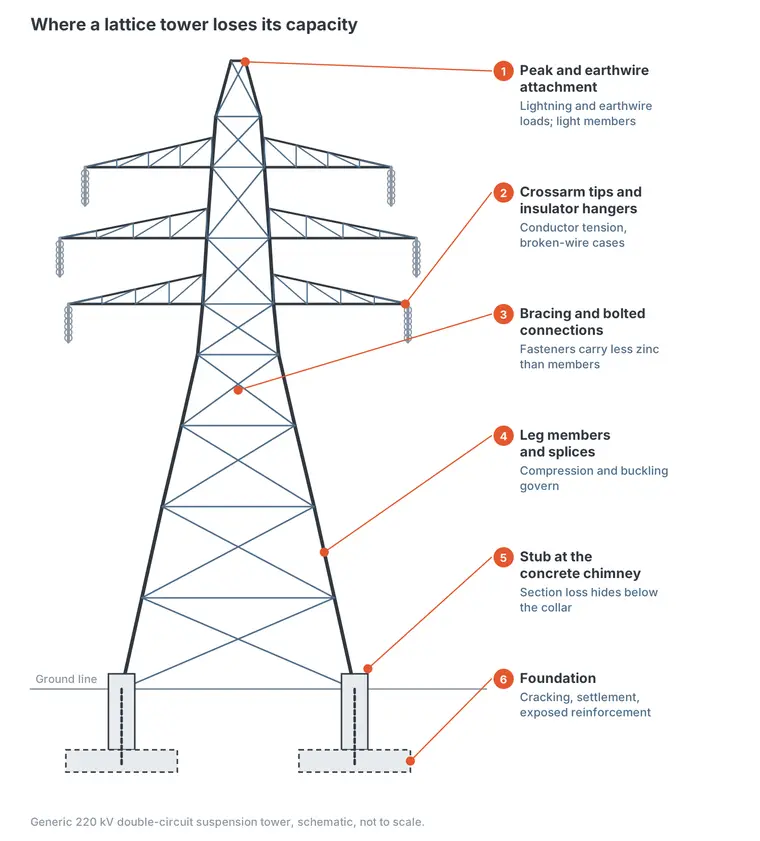
The member that most often decides the outcome is the one hardest to see. The leg stub enters the concrete chimney at ground line, where soil, standing water and vegetation hold moisture against the steel. Section loss there can run well below the visible collar. Research at CSIR-SERC on full-scale tower tests found that premature failure occurred through local buckling of stub members, and the Central Electricity Authority's committee on EHV tower failures has, as reported, identified buckling at stub level as a common route to complete collapse.
Above ground, leg members fail in compression and buckling, so a few millimetres lost from a leg angle costs far more capacity than the same loss from a lightly stressed redundant member. Missing or stolen bracing members change the effective length of the legs they were restraining, which is why a tower can look complete from a distance and be materially weaker than its drawing. Crossarm tips and insulator attachments carry the conductor tension and the broken-wire load cases. The peak carries the earthwire.
This is where the evidence comes from. Drone-based visual inspection covers every member of every tower without a climb. Ultrasonic thickness measurement, one of our conventional NDT methods, turns visible corrosion into a remaining section in millimetres on the critical members. Verticality and deflection are surveyed. Foundation concrete is examined with rebound hammer and ultrasonic pulse velocity, both on our NABL site-testing scope under IS 516 (Part 5), with cores where the owner allows them.
The load side: the code the tower was designed to has moved
Condition evidence answers only half the question. The other half is what the tower is now required to carry.
IS 802 (Part 1/Sec 1), the code for loads on transmission line towers, was first published in 1967 and revised in 1973, 1977, 1995 and, as the fourth revision, in 2015. The 1995 edition set out reliability levels with return periods, Level 1 at 50 years covering lines up to 400 kV, and six basic wind speed zones from 33 m/s to 55 m/s. A tower erected in the mid-1980s was designed before either of the last two revisions.
The national record says this is not academic. The Central Electricity Authority's committee on failures of EHV transmission line towers for 2024, as reported in the trade press, recorded 28 incidents involving 76 towers, 30 of them at 220 kV, and recommended that towers built to older codes be assessed and strengthened to IS 802:2015. The Central Electricity Regulatory Commission, for its part, applies a useful life of 35 years to transmission lines in tariff determination. A line commissioned in 1985 passed that mark in 2020.
So the structural check is not a formality. Each tower type is modelled with its measured, not nominal, section on the members that have lost steel, and checked against the loads the current code sets for that wind zone. That re-analysis is reviewed and signed by the structural engineer of record.
"An owner who asks for the remaining life of a boiler tube is asking how much creep life is left in the metal. An owner who asks the same question of a forty-year-old tower is asking something different: whether the steel still standing can carry the loads today's code says it must. That is a structural question. We answer it with measured section, not with nominal drawings, and we say plainly when a classical RLA would add nothing."
What the owner receives
The assessment ends with a decision per tower, or per representative tower where a type repeats under the same exposure, in one of four forms:
- Continue in service, with an inspection interval matched to the measured corrosion rate
- Repair: replace corroded bolts, missing members and damaged bracing
- Strengthen: add or upgrade members where the measured section fails the current load case
- Investigate further: foundations or members where the evidence is not yet enough to decide
What it deliberately does not do is put a single "years remaining" figure on a tower. A lattice structure does not age along one curve. Its remaining life is the time until the next measured member, at its current corrosion rate, falls below the section the current code requires. That is why a credible answer is a ranked repair and inspection plan, and not a number. The same reasoning sits behind our work on plant life extension for ageing power generation and infrastructure assets.
Continue reading
Frequently asked questions
Can a Remaining Life Assessment be carried out on a transmission line tower?
Yes, but not in the metallurgical sense used for boilers. A galvanised lattice tower at ambient temperature has no creep life to consume. Its remaining life is assessed structurally: measured corrosion loss, connection and foundation condition, and a check of the remaining section against the loads the current edition of IS 802 requires.
How long does galvanising last on a transmission tower?
IS 4759 requires at least 610 g/m² of zinc on members 5 mm and thicker, about 85 µm. Against ISO 9223 first-year zinc rates, that coating lasts roughly 20 to 40 years in a C4 atmosphere and 10 to 20 years in C5. Bolts carry about half as much zinc and usually lose it first.
Where do old lattice towers usually fail?
Most often at the leg stub where it enters the concrete chimney at ground line, where moisture holds against the steel and section loss is hidden. Leg members fail in buckling, so modest thickness loss there matters most. Corroded or missing bolts and bracing members also reduce capacity well before a tower looks damaged.
Why does a 1980s tower need to be checked against IS 802:2015?
IS 802 has been revised twice since the mid-1980s, in 1995 and 2015, changing the basis on which wind loads are set. The Central Electricity Authority's committee on 2024 EHV tower failures recommended that towers built to older codes be assessed and strengthened to IS 802:2015.
What does a structural integrity assessment of a transmission line deliver?
Condition evidence for every tower from drone survey, thickness measurement, verticality survey and foundation testing, a structural re-analysis of each tower type using measured rather than nominal sections, and a tower-by-tower decision: continue in service, repair, strengthen, or investigate further, with an inspection interval.