
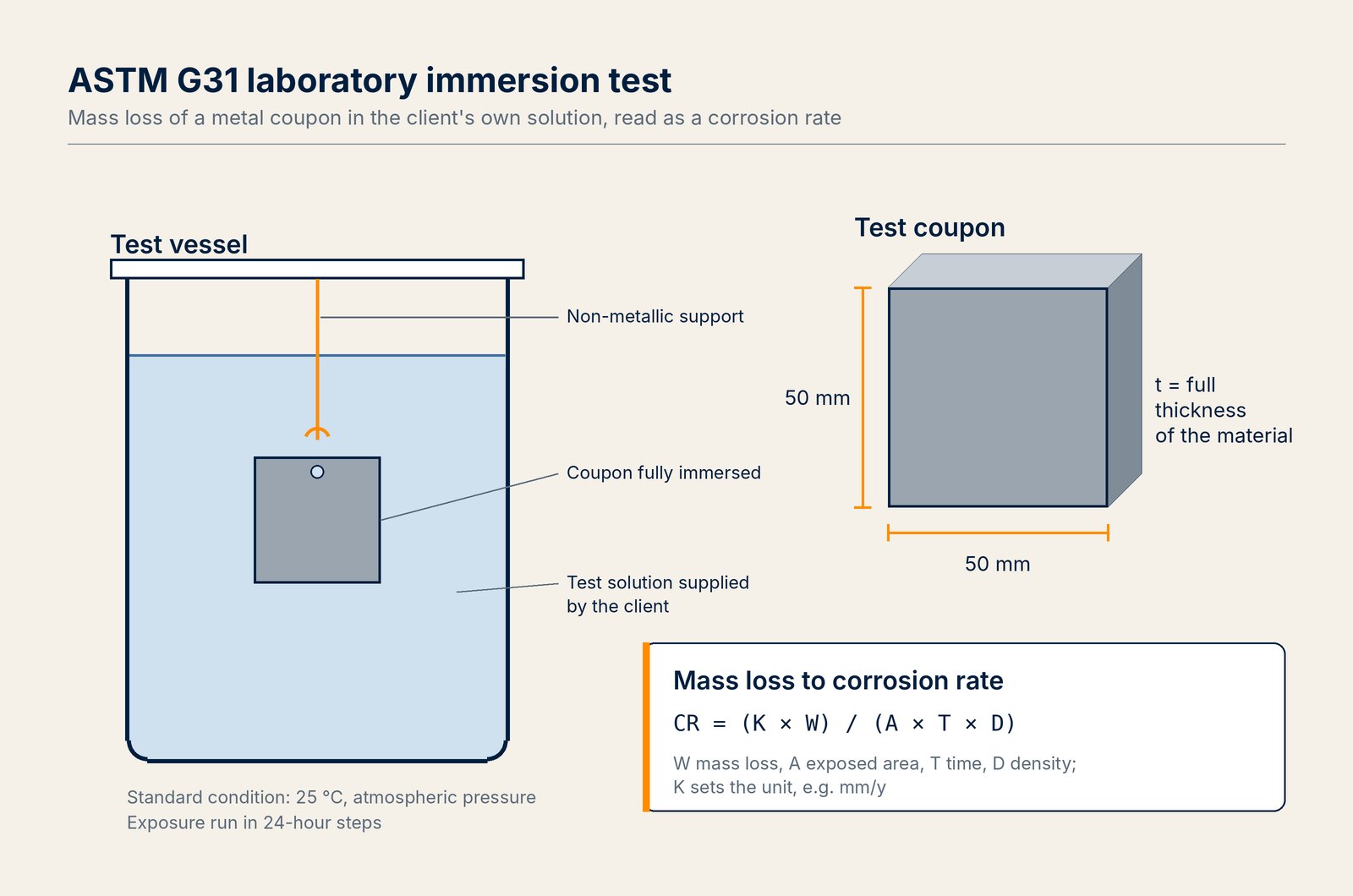
TCR Engineering runs laboratory immersion corrosion tests to ASTM G31 at its Mahape laboratory in Navi Mumbai. A coupon of the client's own metal is immersed in the client's own solution, weighed before and after exposure, and reported as weight loss and corrosion rate. The standard condition is 25 °C at atmospheric pressure, in 24-hour steps. ASTM G31 is not on NABL certificate NABLT0726MH18640.
- Standard: ASTM G31-21(2025), the Standard Guide for Laboratory Immersion Corrosion Testing of Metals, published jointly with AMPP (formerly NACE) as NACE TM0169/G31.
- Specimen: 50 mm wide by 50 mm long by the full thickness of the material, prepared, cleaned and evaluated per ASTM G1.
- Test solution: supplied by the client. TCR does not make up a client's proprietary chemical.
- Standard condition: 25 °C at atmospheric pressure, exposure in 24-hour increments: the first 24 hours, then each additional 24 hours.
- Result: weight loss and corrosion rate.
- Accreditation position: the laboratory is NABL accredited under certificate NABLT0726MH18640; ASTM G31 is not on that scope, and immersion results are reported outside the accredited scope.
- Where it sits: on the corrosion and sour service bench, beside ASTM A262, G28, G48 and the NACE sour-service methods.
The question a datasheet cannot answer
A corrosion table in a handbook tells an engineer how a grade behaves in a named acid at a named concentration and temperature. It does not tell them how their plate behaves in their cleaning chemical, their inhibitor package or their process liquor, because nobody else has tested that liquid on that material. The formulation is often proprietary, the concentration is the one the plant actually doses, and the metal is the heat that is actually in the equipment.
That is the gap an immersion test closes. It puts a measured piece of the real material into the real liquid for a measured time and weighs what the metal has lost. The answer is specific to that pair, which is exactly why it is useful: it ranks candidate alloys for a new duty, it checks whether a cleaning or decontamination chemical will attack the equipment it is meant to clean, and it compares inhibited against uninhibited solutions on the same metal.
What ASTM G31 is, and the edition to cite
ASTM G31 is a guide, not a fixed recipe. Its current form is ASTM G31-21(2025), the 2021 edition reapproved in 2025, titled Standard Guide for Laboratory Immersion Corrosion Testing of Metals. Earlier editions carried the title Standard Practice. AMPP publishes the same document jointly as NACE TM0169/G31, so a specification may name either designation for the same method.
Its scope is the set of factors that decide a laboratory immersion test, with particular attention to mass loss tests:
- the apparatus, sampling and test specimen;
- the test conditions;
- the methods of cleaning the specimens after exposure;
- the interpretation of results and the calculation of corrosion rates;
- a checklist for reporting the test data.
Three things are deliberately outside it: localised attack, environmentally assisted cracking, and the effects of solution flow. Those are separate tests with their own standards, and a sound programme states which of them it needs.
Because it is a guide, the purchaser's conditions are what turn it into a test. A report that says "tested to ASTM G31" and gives no solution, temperature, duration or specimen description has told the reader very little.
From grams lost to millimetres per year
The calculation behind a mass-loss corrosion rate uses four measured quantities and one constant:
| Symbol | Quantity | Unit used here |
|---|---|---|
| W | Mass loss of the coupon after exposure and cleaning | g |
| A | Exposed surface area of the coupon | cm² |
| T | Exposure time | h |
| D | Density of the metal | g/cm³ |
| K | Constant that sets the reporting unit | 8.76 × 10⁴ for mm/y |
Corrosion rate = (K × W) / (A × T × D). The constant follows from the units: one gram lost from one square centimetre of a metal of density 1 g/cm³ in one hour is a 1 cm loss of thickness per hour, or 87,600 mm a year. A peer-reviewed application of the relation uses the same constant for mm/y with these units.
An illustrative calculation, not a result: a carbon steel coupon 50 mm by 50 mm cut from 6 mm plate has an exposed area of 62 cm², two faces of 25 cm² and four edges of 3 cm². If it loses 0.050 g in 72 hours at a density of 7.86 g/cm³, the corrosion rate is 0.125 mm/y.
Two cautions travel with every such number. The relation assumes the attack is spread evenly over the surface; where the loss is concentrated in pits or at the edges, the averaged rate understates the local penetration, and pitting and crevice testing to ASTM G48 answers a different question. And the mass loss is only as good as the cleaning: corrosion product has to come off without removing sound metal, which is what ASTM G1 governs.
The coupon, and why full thickness
TCR's standard immersion coupon is 50 mm wide by 50 mm long and keeps the full thickness of the material. Keeping the mill thickness means the coupon carries the product's own surfaces and through-thickness structure rather than a thin slice machined from somewhere in the middle, and it keeps the edges, where cut surfaces corrode differently, in their real proportion to the faces.
The coupons are cut and finished in TCR's machine shop, which already makes corrosion coupons for the laboratory and for clients, as the post on manufacturing corrosion metal coupons describes. Each coupon is measured and weighed before exposure, and after exposure it is cleaned to ASTM G1 and weighed again. Where the grade itself is in doubt, chemical analysis confirms it before the coupon goes in, and a section on the metallurgical evaluation bench shows the attack where the reader needs to see it as well as weigh it.
The solution comes from the client. That is not a convenience: the result describes the client's liquid only if it is the client's liquid, at the client's concentration, from the client's batch. Where a different temperature or a longer duration is needed, it is agreed with the client in writing before the specimens go in.
"A datasheet tells you how a grade behaves in a solution somebody else chose. Our clients need to know how their plate behaves in their own chemical, and the honest way to answer that is to put a coupon of that plate into that liquid and weigh what it has lost. We keep the coupon at full thickness, expose it in measured 24-hour steps and clean it to ASTM G1 before it goes back on the balance, so the number we report is a mass we measured, not one we estimated."
Manoj Prabhakar Singh heads conventional and corrosion testing at Mahape, where he oversees intergranular corrosion testing to ASTM A262, pitting and crevice corrosion testing, and sour-service testing to NACE TM0177 and TM0284.
Where an immersion test is used
Any industry that puts a metal into a liquid and needs to know what the liquid will do to it uses this kind of test. The common cases:
| Industry | Liquids typically tested |
|---|---|
| Chemicals and speciality chemicals | Process liquids, chemical cleaning and decontamination formulations, corrosion inhibitors |
| Refining and petrochemicals | Turnaround cleaning and decontamination chemicals, neutralisers, inhibitor packages |
| Fertilisers | Acid and ammoniacal process liquors, cleaning solutions |
| Oil and gas upstream | Acidising fluids, inhibitor packages, produced water |
| Pipelines and city gas | Pipeline cleaning and pigging chemicals, decontamination chemicals |
| Power generation | Boiler chemical cleaning solutions, cooling water treatment chemicals |
| Water treatment and desalination | Treated water, brine, dosing chemicals |
| Pharmaceutical and food processing | Clean-in-place chemicals and process liquids on stainless equipment |
| Pulp and paper | Pulping and bleaching liquors |
| Automotive | Engine coolants, cleaning and pretreatment baths |
| Marine and offshore | Seawater, ballast and cleaning chemicals |
ASTM G31 is a method for metals. Elastomers and polymers in service fluids are a different family of tests; the qualification TCR publishes for those is the NORSOK M-710 programme on the composites and polymers page.
What an enquiry should carry
The test is fixed in writing before the coupons go in, and the enquiry is what fixes it. Send:
- The material: grade, product form and thickness, and the quantity available for coupons.
- The solution: enough of it for the exposure, with its safety data sheet and the concentration it represents.
- The exposure: the number of 24-hour steps required, and any temperature other than 25 °C, which is agreed in writing.
- The reporting: the corrosion rate unit the specification uses, and whether the cleaned coupons are to be photographed or returned.
- The specification: the purchase or plant specification that calls for the test, if there is one.
For a buyer, this is the cheapest point at which to learn that a chemical and a metal do not agree. For a plant engineer, it is evidence on the record before a cleaning contractor or a chemical supplier is approved. For both, the related weight loss corrosion testing to ASTM A262 and NACE RP0775 sits on the same bench.
Frequently asked questions
What does an ASTM G31 immersion corrosion test measure?
It measures how much mass a metal coupon loses when immersed in a specific liquid for a defined time. The mass loss, the exposed area, the exposure time and the metal's density give a corrosion rate, usually in millimetres per year, for that metal in that liquid under those conditions.
What specimen does TCR need for an ASTM G31 test?
TCR's standard coupon is 50 mm wide by 50 mm long and keeps the full thickness of the material. Coupons are prepared, cleaned and evaluated per ASTM G1, and TCR's Mahape machine shop can cut them from the client's material where the client prefers.
Who supplies the test solution for an immersion test?
The client supplies the solution. The result describes the client's liquid only if it is the client's liquid, at the concentration and from the batch the plant actually uses. TCR does not make up a client's proprietary chemical, and the solution should arrive with its safety data sheet.
What are the standard test conditions at TCR's Mahape laboratory?
The standard condition is 25 degrees Celsius at atmospheric pressure, with exposure in 24-hour increments: the first 24 hours, then each additional 24 hours. Weight loss and corrosion rate are reported. Any other temperature or duration is agreed with the client in writing before the coupons go in.
Is ASTM G31 testing covered by TCR's NABL accreditation?
No. TCR Engineering's Mahape laboratory holds NABL certificate NABLT0726MH18640, and ASTM G31 is not on that scope. Immersion corrosion results are therefore reported outside the accredited scope, and the report says so plainly. A specification that requires accredited results should say so at enquiry, so the position is agreed before testing starts.