
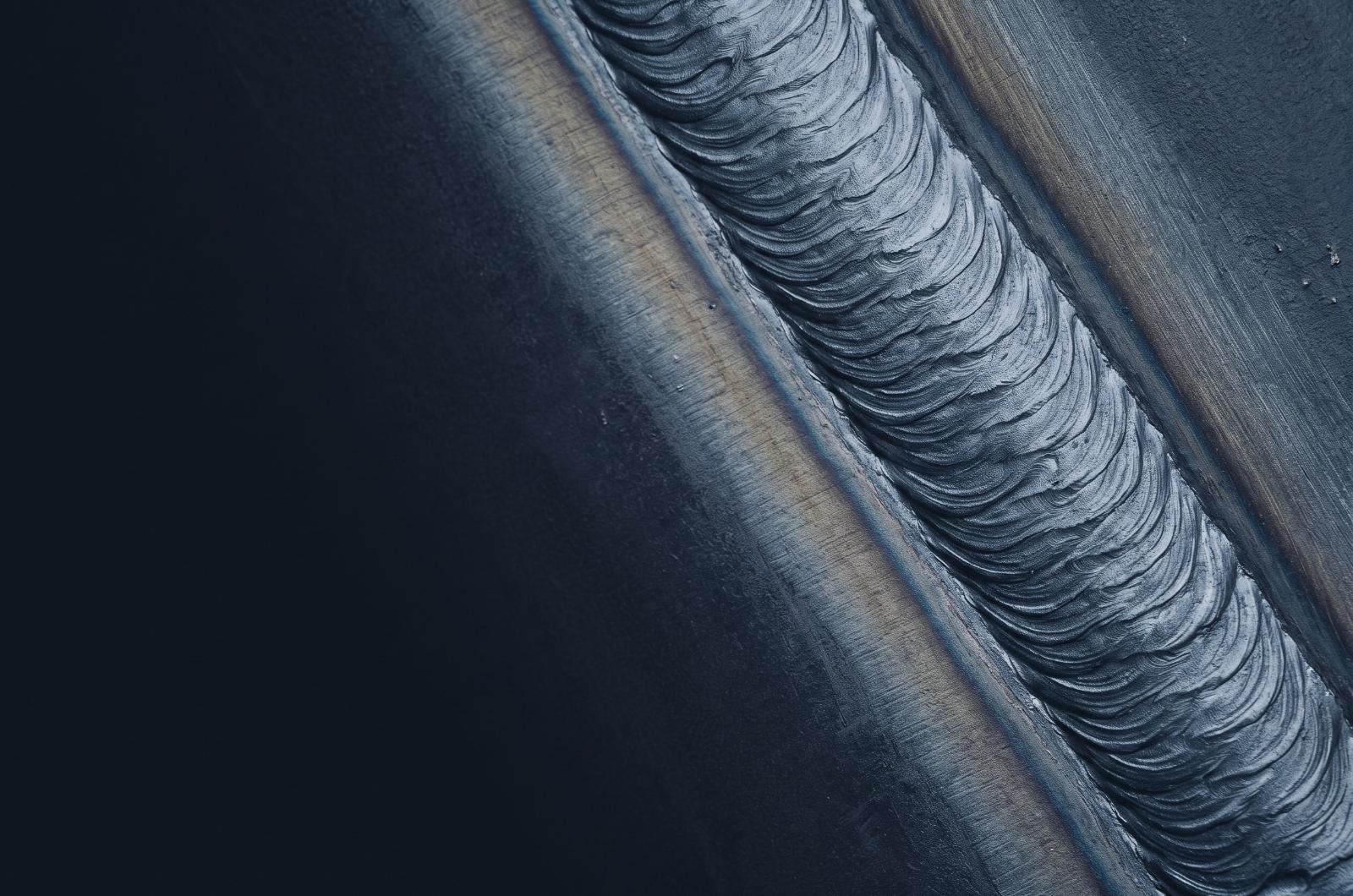
TCR Engineering qualifies welding procedures and welders to ASME Section IX, AWS D1.1 and API 1104: it writes the WPS, witnesses the coupon with CSWIP and AWS certified welding inspectors, and tests it at its NABL accredited laboratory (NABLT0726MH18640) in Mahape, Navi Mumbai. Three records come out of that work, a WPS, a PQR and a WPQ, and each proves something different.
- Codes: ASME Section IX for pressure equipment, AWS D1.1 for structural steel, API 1104 for pipelines, chosen by the construction code.
- The records: the WPS instructs, the PQR proves the procedure, the WPQ proves one welder.
- On the NABL scope: weld tensile, bend and fracture tests to ASME Section IX and AWS D1.1; macro etch to ASME Section IX; macro examination of throat length and leak path to ASME Section IX and AWS D1.1; tensile, bend and nick break to API 1104; Charpy impact to ISO 9016; radiography of welds to ASME Section V Article 2; liquid penetrant testing to ASME Section V Article 6.
- Outside it, by nature: writing the WPS, witnessing and endorsement, which are inspection services signed by named, certified people.
- Where: the Mahape laboratory, and in Saudi Arabia TCR Arabia, the group's joint venture in Dammam.
Three records, three different proofs
A welding procedure specification (WPS) is an instruction: process, base metal, filler, shielding gas, joint design, positions, preheat and interpass temperatures, electrical parameters and any post-weld heat treatment. The procedure qualification record (PQR) is history: the parameters actually used to weld a test coupon, and the result of every test the coupon passed. The welder performance qualification (WPQ) records that one identified welder, working to a qualified WPS, deposited sound weld, and states the positions, thicknesses and processes that welder may now weld.
| Record | What it proves | What it does not prove |
|---|---|---|
| WPS | Nothing, until a PQR supports it | That the instruction produces sound weld |
| PQR | That the procedure gives weld with the required properties | That any other welder can follow it |
| WPQ | That this welder deposits sound weld within the stated range | That the procedure is qualified |
One overlap is often missed. ASME Section IX states that a welder who welds an acceptable procedure qualification coupon is also qualified, within the limits of performance qualification. A shop qualifying a new procedure and five welders needs the PQR coupon and four further welder tests, not five, if one of the five welds the coupon. The reverse never holds: no number of passed welder tests qualifies a procedure.
The construction code decides the qualification code
A pressure vessel built to ASME Section VIII calls for procedures and welders qualified to ASME Section IX. A steel structure built to AWS D1.1 is qualified to AWS D1.1, and a cross-country pipeline to API 1104. Enquiries often name a code out of habit. A qualification under one code is not automatically accepted under another, and the purchaser decides. Read the purchase specification before the coupon is cut.
Prequalified, or qualified by test
AWS D1.1 offers a route that removes the procedure test: the prequalified WPS. A procedure inside the code's prequalified limits (listed base metals, prequalified processes and joint details, matching filler and the tabulated minimum preheat) needs no PQR coupon. It must still be written down and followed, and its welders must still be qualified.
The route closes as soon as one condition falls outside the list. GMAW in short-circuit transfer is not a prequalified process under AWS D1.1. A base metal the code does not list as approved must be qualified by test, and many medium-carbon steels fall in that group. A steel with around 0.45 per cent carbon is typical: its hardenability is high, the heat-affected zone can form hard martensite, and the joint is susceptible to hydrogen cracking. Preheat, interpass temperature, low-hydrogen consumable handling and, where the design allows, post-weld heat treatment are decided in the WPS and proved on the coupon. AWS D1.1 does not require a hardness survey to qualify the procedure, but on a high-carbon-equivalent steel a Vickers traverse across the macro section is direct evidence that the preheat was right.
This is where an in-depth WPS earns its place: preheat stated against the thickest joint, the interpass maximum, consumable baking and storage, and what happens if welding is interrupted. Welders read those lines.
Essential variables, and why coupon thickness is a decision
Change an essential variable beyond its permitted range and the procedure, or the welder, must be requalified.
| Variable | Typical effect of a change |
|---|---|
| Welding process | New qualification |
| Base metal group (P-number under ASME Section IX) | New qualification outside the group |
| Thickness | Range limited by the code's tables |
| Filler metal classification | Requalification outside the grouping |
| Shielding gas | Can require requalification under both codes |
| Position | Welder limited to the tabulated positions |
| Preheat | A decrease beyond the permitted limit requires requalification |
| Post-weld heat treatment | Adding or removing PWHT requires a new PQR |
| Heat input, where toughness is required | An increase beyond the qualified value requires requalification |
The qualified thickness range comes from the code's tables. Under ASME Section IX a groove coupon of 38 mm (1.5 in) qualifies base metal up to 200 mm (8 in). In recent editions of AWS D1.1, a complete joint penetration groove test plate of 25 mm and over qualifies plate from 3 mm with no upper limit, subject to the table's notes. A fabricator welding 100 mm plate does not need a 100 mm coupon to satisfy the range.
The range is a legal answer, not a metallurgical one. A thick section draws heat from the weld faster than a thin coupon, so a 25 mm coupon can pass every test while the 100 mm production joint, at the same preheat, forms a harder heat-affected zone. On a high-carbon-equivalent steel, choosing the coupon against the thickest production joint is the safer decision. If production joints are stress relieved, the coupon must be too: post-weld heat treatment is an essential variable. And under ASME Section IX a change between short-circuit transfer and the other GMAW modes is an essential variable for the welder.
What the coupon goes through, code by code
Every coupon starts with visual examination. The mechanical testing and non-destructive testing that follow are set by the code, the weld type and, for pipe, diameter and wall thickness.
| Code | Procedure qualification, groove weld (main tests) | Welder qualification, groove weld |
|---|---|---|
| ASME Section IX | Two tension tests (thick coupons in multiple pieces) and four guided bends; Charpy tests when the construction code requires toughness | Bend tests, or radiography where the code permits (never for GMAW in short-circuit transfer) |
| AWS D1.1 | Visual and NDT of the plate, then reduced-section tension and bend tests; Charpy tests when the contract calls for them | Bend tests, or radiography where the code permits (never for GMAW in short-circuit transfer) |
| API 1104 | Tensile, nick-break and bend specimens, the number set by pipe diameter and wall thickness | Visual examination, then the tests the standard sets for the qualification type |
Many enquiries ask for "any one NDT, such as dye penetrant or radiography". For a groove weld qualification under ASME Section IX or AWS D1.1, dye penetrant testing is not an alternative to bend tests or radiography; it finds surface-breaking flaws only, and in qualification it is used mainly on overlays and tube-to-tubesheet welds. Where one NDT stands in for the bends, it is radiography.
Read against the annexure to certificate NABLT0726MH18640, the coupon tests sit on the NABL scope as follows:
| Test on the coupon | Standard | On NABL scope |
|---|---|---|
| Tensile (strength, yield, elongation) | ASME Section IX, AWS D1.1, API 1104, ISO 4136 | Yes |
| Bend | ASME Section IX, AWS D1.1, API 1104, ISO 5173 | Yes |
| Fracture | ASME Section IX, AWS D1.1 | Yes |
| Macro etch | ASME Section IX | Yes |
| Macro examination: throat length, leak path | ASME Section IX, AWS D1.1 | Yes |
| Macro examination: leg length | ASME Section IX, API 1104 | Yes |
| Nick break | API 1104 | Yes |
| Charpy impact; Vickers hardness | ISO 9016; ISO 9015 | Yes |
| Radiography; liquid penetrant | ASME Section V Article 2; Article 6 | Yes |
| WPS preparation, witnessing, endorsement | The governing code | Inspection service, not a laboratory test |
Every scoped row above is on the Permanent Testing (laboratory) scope at Mahape. Radiography to ASME Section V Article 2 and liquid penetrant testing to Article 6 are also on the Site Testing scope.
Chemical analysis and CTOD fracture toughness are added where a specification calls for them, as in our post on CTOD testing of welding electrodes.
What the third-party witness adds
A purchaser who asks for a witnessed qualification is buying a chain of custody, not a signature. The witnessing inspector checks base metal and filler certificates against the WPS, confirms each welder's identity, watches the coupon welded and records the actual parameters, marks the coupon so it cannot be substituted, witnesses specimen cutting and testing, and reviews the results against the code before endorsing the PQR or WPQ.
Purchasers often specify the credential: CSWIP 3.1 Welding Inspector or AWS Certified Welding Inspector. Both are issued and renewed by a body other than the employer, under a published scheme, so the owner can verify them. TCR can deploy CSWIP and AWS qualified welding inspectors, and its welding inspection service covers the chain from WPS to endorsed record.
TCR's welding department is led by Sachin Ram Bhadange, Welding Engineer and Coordinator, an IIW-certified International Welding Specialist (IWS) and IIW-certified welding inspector (CWI-S). As the fabricator's external welding coordinator, he reviews and endorses the WPS, PQR and WPQ, guides procedures and work instructions, and trains welders before they test. TCR and TCR Arabia both issue welder identity cards.
"Most welding qualification enquiries arrive as a list of tests: bend, tensile, one NDT. The tests are the easy part. The decisions that fail a qualification are made before the coupon is cut: which code the purchaser actually named, which base metal group the steel falls in, what thickness the coupon has to represent, and whether the joint will be heat treated. Our inspectors witness the welding, mark the coupon and follow it through the laboratory, but the most useful hour is the one spent on the WPS before anyone strikes an arc."
Shailendra Singh heads non-destructive testing and third-party inspection at TCR Engineering, Navi Mumbai. Our post on rebuilding a 13Cr valve seat on a WCB body shows a case where the weld type, not the test list, decided the qualification.
What an enquiry should carry
A welder and procedure qualification is fixed before the first coupon is welded. Send:
- The code and edition named in the purchase specification, and the construction code it serves.
- The process and transfer mode: SMAW, GTAW or GMAW, and for GMAW short-circuit, spray or pulsed.
- The base metal: specification, grade, mill certificate and the thickest production joint.
- Filler and gas: classification and shielding gas composition, with any backing gas.
- Joints and positions: plate or pipe, groove or fillet, and the positions the work needs.
- Heat treatment and toughness: whether joints are post-weld heat treated, and any impact test temperature.
- The welders: how many, and whether one will weld the PQR coupon.
- The scope: WPS written or reviewed by TCR, witness at the works or the laboratory, and endorsement.
- Pipe coupons: pipe diameter and wall thickness, which set the number of coupons and specimens.
Programme dates are confirmed in the quotation.
Frequently asked questions
What is the difference between a WPS, a PQR and a WPQ?
A WPS is the written instruction for making a weld. A PQR is the record that a coupon welded to that instruction passed the code's tests, which is what qualifies the WPS. A WPQ is the record that one named welder deposited sound weld within a stated range of positions, thicknesses and processes. Each proves something the others do not.
Does a welder who welds the PQR coupon also need a separate welder test?
Under ASME Section IX, a welder who welds an acceptable procedure qualification coupon is also qualified within the limits of performance qualification, so no separate test is needed for that welder. Every other welder who will use the procedure must pass a performance test of their own. A passed welder test never qualifies a procedure.
When does AWS D1.1 require a WPS to be qualified by test?
Whenever any condition falls outside the prequalified limits, such as a base metal the code does not list for prequalified use, GMAW in short-circuit transfer, or a joint detail that is not prequalified. Many medium-carbon steels fall outside the list and need a qualification by test, with preheat and hydrogen control proved on the coupon.
Can dye penetrant testing replace bend tests in a welder qualification?
No. For a groove weld qualification under ASME Section IX or AWS D1.1, dye penetrant testing is not an alternative to bend tests. Radiography can replace bend tests in many cases, but not for GMAW in short-circuit transfer, where bend tests are required. Penetrant testing finds only surface-breaking flaws and has its qualification role on overlays and some fillet tests.
Which weld qualification tests are on TCR Engineering's NABL scope?
Tensile, bend and fracture tests to ASME Section IX and AWS D1.1, macro etch to ASME Section IX, tensile, bend and nick break tests to API 1104, bend tests to ISO 5173, Charpy impact to ISO 9016 and radiography of welds to ASME Section V are on NABL certificate NABLT0726MH18640. Writing the WPS, witnessing and endorsement are inspection services, not laboratory tests.