
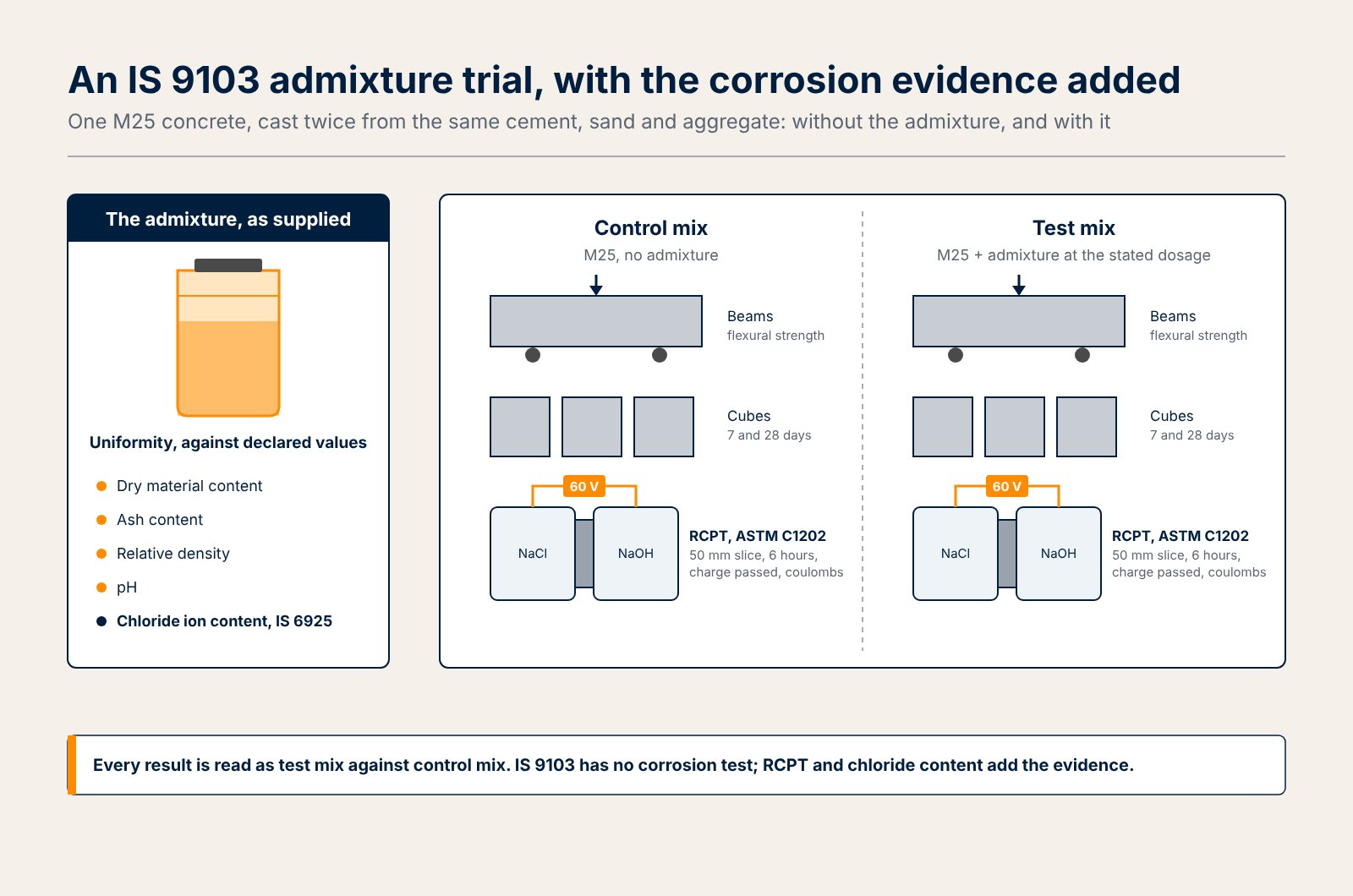
TCR Engineering evaluates concrete admixtures to IS 9103 at its Mahape laboratory in Navi Mumbai, and enquiries often ask for "corrosion testing as per IS 9103". The standard contains no corrosion test. What it contains is a controlled comparison between concrete made with the admixture and concrete made without it, and that comparison is the right place to build corrosion-relevant evidence: a rapid chloride penetration test on both mixes, and the chloride ion content of the admixture itself.
- Standard: IS 9103:1999, Concrete Admixtures, Specification (First Revision), with Amendments No. 1 and No. 2.
- What it does not contain: a corrosion test on steel. Its corrosion content is a chloride declaration and a warning.
- What it does contain: uniformity tests on the admixture, and performance tests on a test mix against a control mix.
- The corrosion-relevant additions: rapid chloride penetration test (RCPT) to ASTM C1202 on both mixes, and chloride ion content of the admixture to IS 6925.
- On the NABL scope: the five admixture uniformity tests, flexural and compressive strength to IS 516, and RCPT to ASTM C1202, all on certificate NABLT0726MH18640.
- Outside the NABL scope: the trial mix design itself, bleeding, air content and length change, reported as standard laboratory testing.
- Programme: set by the test ages chosen (7 and 28 days, and any 6-month and 1-year length change), and confirmed in the quotation.
What IS 9103 says about corrosion, and what it leaves out
IS 9103 covers accelerating, retarding, water-reducing, air-entraining and superplasticising admixtures. Its only direct treatment of corrosion is in its scope clause on chloride. The manufacturer has to declare the chloride content of the admixture. Superplasticisers are expected to be chloride free. Admixtures with a high chloride content can accelerate the corrosion of prestressing steel, and the standard says plainly that compliance with it does not by itself make an admixture suitable for prestressed concrete. For reinforced concrete, it points to the limits on total chloride in the concrete set by IS 456.
That is a declaration and a warning, not a test. Nothing in IS 9103 places steel in concrete, drives chloride towards it and measures what happens. A supplier who needs that kind of evidence has three choices, and they answer different questions:
| Evidence | What it measures | Duration | Where it fits |
|---|---|---|---|
| Chloride ion content of the admixture, IS 6925 | How much chloride the admixture itself brings into the concrete | Days | Every admixture; IS 9103 uniformity check |
| Rapid chloride penetration test, ASTM C1202 | The electrical charge passed through a concrete slice, as an indicator of resistance to chloride ion penetration | 6 hours per specimen, after curing | A control and test mix comparison |
| Macrocell corrosion test, ASTM G109 | Corrosion current between steel bars in concrete exposed to chloride | Months | Corrosion inhibiting admixtures where service-life evidence is needed |
The first two sit naturally inside an IS 9103 trial. The third is a separate programme, discussed in our post on bipolar corrosion inhibiting admixture testing.
Two halves of one trial
An IS 9103 evaluation has two halves that are easy to run together in a tender document and should not be.
The uniformity half tests the admixture as supplied. It checks that the drum delivered matches what the manufacturer declared, against the tolerances in the standard's uniformity table:
| Uniformity test | IS 9103 method | Tolerance against the declared value | On NABL scope |
|---|---|---|---|
| Dry material content | Oven drying at 105 ± 2 °C | 95 to 105 per cent of the declared value | Yes |
| Ash content | Ignition at 600 °C | 95 to 105 per cent of the declared value | Yes |
| Relative density | Hydrometer at 20 ± 5 °C | Within 0.02 | Yes |
| Chloride ion content | IS 6925 | Within 10 per cent or 0.2 per cent, whichever is greater | Yes |
| pH | pH meter | Compared with the declared value, to the amended clause | Yes |
Every tolerance is relative to a declared value. An admixture sent without the manufacturer's declared values can be measured, but it cannot be judged against IS 9103, which is why the declaration belongs in the enquiry.
The performance half tests concrete. The same concrete is made twice: a control mix without the admixture and a test mix with it, from the same cement, the same fine aggregate and the same coarse aggregate. Each property is then reported for the test mix as a comparison against the control: water content as a percentage of the control, setting time as a difference in hours, compressive and flexural strength as a minimum percentage of the control, length change and bleeding as a maximum increase over the control, and air content over the control. The comparison is the whole point. A test mix result read on its own says nothing about the admixture.
A general evaluation, or a mix for the job
IS 9103 allows two kinds of performance trial, and the choice changes what the report can claim.
The general evaluation uses a reference mix fixed by the standard: ordinary Portland cement at 307 ± 3 kg/m³, Zone II fine aggregate, 20 mm coarse aggregate and a slump of 50 ± 10 mm. It answers whether the admixture performs as its type claims, on a mix any laboratory can repeat.
The specific-use evaluation uses the cement content, workability and strength of the concrete the admixture is meant for. A trial on an M25 mix designed to IS 10262 is of this kind. It answers a narrower and more practical question: what the admixture does to the concrete the client will actually pour.
A trial on a commonly used grade such as M25 shows a buyer the product in a mix that looks like their own. The report says which kind of trial it is, and a specific-use result should not be read as a general type approval.
Where RCPT fits, and where it can mislead
RCPT to ASTM C1202 is the corrosion-relevant test most often added to an admixture trial, and it is on the laboratory's NABL scope. A 50 mm slice of 100 mm diameter concrete, cut from a cylinder or core, is held between two cells, one with sodium chloride solution and one with sodium hydroxide solution, and a potential difference of 60 V is maintained across it for 6 hours. The charge passed, in coulombs, is read against the standard's five bands, from negligible below 100 coulombs to high above 4,000.
Run on both mixes from the same trial, RCPT gives a direct comparison: does the admixture leave the concrete more or less resistant to chloride ion penetration than the control. For a water-reducing admixture or a superplasticiser, which lowers the water content for the same workability, a lower charge passed on the test mix is the expected and useful result.
ASTM C1202 also carries a caution that matters to anyone selling a corrosion inhibitor. The method measures electrical conductance, not chloride movement directly, and the standard itself warns that it can give misleading results where calcium nitrite has been admixed into the concrete, with a note that other admixtures might affect results similarly. An admixture that adds ions to the pore solution can raise the coulomb value of a concrete that long-term ponding would show to be at least as resistant. For an ionic corrosion inhibitor, a higher RCPT result on the test mix is therefore not, on its own, evidence that the product harms durability, and the report should say so. Where that question matters, the evidence is a long-duration test such as ASTM G109 or chloride ponding, specified as a separate programme.
"Admixture makers often ask us for corrosion testing to IS 9103, and the honest first answer is that the standard does not have one. What it does have is a fair comparison: the same M25 concrete cast twice, once with the admixture and once without, from the same cement, sand and aggregate. Put RCPT on both mixes and the chloride ion content of the admixture beside them, and the client has corrosion-relevant evidence on the same footing as the rest of the IS 9103 report."
Parul Hariya heads civil and building materials testing at TCR Engineering's Mahape laboratory.
What sits on the NABL scope, test by test
A trial report carries tests from both sides of the accreditation boundary, and the report marks each one. Read against the annexure to certificate NABLT0726MH18640:
| Test in the trial | Method | On NABL scope |
|---|---|---|
| Dry material content, ash content, relative density, pH | IS 9103 | Yes |
| Chloride ion content (water soluble chlorides) | IS 6925 | Yes |
| Flexural strength, beams | IS 516 (Part 1/Sec 1) | Yes |
| Compressive strength, cubes | IS 516 (Part 1/Sec 1) | Yes |
| Rapid chloride penetration test | ASTM C1202 | Yes |
| Trial mix design, control and test mixes | IS 10262 | No |
| Bleeding, air content, length change | IS 9103 | No |
Tests outside the scope are carried out to the same procedures in the same laboratory and reported as standard laboratory testing, named as such. Admixture testing sits within TCR's building materials testing, and the concrete side within concrete, cement and aggregates. Both are part of the wider civil testing practice that serves construction and infrastructure projects.
What the time and the ages mean
A trial runs through mix design and trial batches, casting of the control and test mixes, curing, and testing at each age, with RCPT after curing; the programme is confirmed in the quotation. The ages decide the length of the programme. IS 9103 lists compressive strength at ages up to one year for the general evaluation, and length change at 28 days, 6 months and 1 year. A trial reported at 28 days is complete for what it covers, and the report states the ages it covers. A client who needs the 6-month and 1-year length change should say so at the start, because those specimens are cast with the rest.
What an enquiry should carry
The trial is fixed before the first batch is mixed, and the enquiry is what fixes it. Send:
- The admixture: product name, type under IS 9103 (accelerating, retarding, water-reducing, air-entraining or superplasticising) and batch number.
- Declared values: dry material content, ash content, relative density, chloride ion content and pH, as the manufacturer declares them. Without them, the uniformity tests cannot be judged.
- The dosage: the manufacturer's recommended dosage, per unit mass of cement.
- The trial: general evaluation or specific use, and for specific use the grade of concrete, for example M25.
- The test list: which IS 9103 performance tests are required, whether RCPT is to be added, and the ages.
- Materials: for each mix, two bags of cement, three of fine aggregate and four of coarse aggregate, unless the laboratory is to source them, and 5 litres of the admixture as supplied, with its safety data sheet.
The Sample Size Requirements document sets out sample quantities across TCR's other tests.
Frequently asked questions
Does IS 9103 include a corrosion test for concrete admixtures?
No. IS 9103 requires the manufacturer to declare the chloride content of an admixture and warns that high-chloride admixtures can accelerate corrosion of prestressing steel, but it has no test that measures corrosion of steel. Corrosion-relevant evidence is added to an IS 9103 trial through RCPT on both mixes and the chloride ion content of the admixture.
Which IS 9103 tests are on TCR Engineering's NABL scope?
Dry material content, ash content, relative density and pH to IS 9103, and chloride ion content to IS 6925, are on NABL certificate NABLT0726MH18640, as are flexural and compressive strength to IS 516 and RCPT to ASTM C1202. The trial mix design, bleeding, air content and length change are reported as standard laboratory testing.
Why does an IS 9103 trial need a control mix?
Every IS 9103 performance requirement is a comparison. Water content, setting time, strength, length change, bleeding and air content are judged for the test mix against a control mix made without the admixture from the same cement and aggregates. A test mix result on its own says nothing about what the admixture did.
Can RCPT give a misleading result for a corrosion inhibiting admixture?
It can. ASTM C1202 measures electrical conductance, and the standard warns that calcium nitrite, and possibly other admixtures, can raise the charge passed in concrete that long-term ponding shows to be at least as resistant. A higher RCPT value with an ionic inhibitor is not on its own evidence of reduced durability.
What decides the length of an IS 9103 admixture trial?
The test ages decide it. A trial covers mix design, casting of the control and test mixes, curing and testing at each age, typically 7 and 28 days, with the programme confirmed in the quotation. Length change at 6 months and 1 year, if required, extends the programme and should be requested at the start.