
On 1 August 2024 Yangzhou Chengde Steel Pipe Co., Ltd. of Jiangsu, China, placed an order on TCR Engineering's Navi Mumbai laboratory for hydrogen induced cracking and sulphide stress cracking testing on line pipe destined for a Petroleum Development Oman project. The order named the methods, the durations, the environment and the specimen geometry. It also named two conditions that cannot both be true.
That second fact is the case study. The testing itself is routine work for a sour service corrosion laboratory. What decides whether a qualification programme succeeds is whether somebody reads the purchase order closely enough to catch a specification that has been transcribed across three organisations and has lost a digit on the way.
What the order specified
| Test | Method | Duration | Temperature | Environment | Specimens |
|---|---|---|---|---|---|
| Hydrogen induced cracking | NACE TM0284 | 96 hours | 25 ± 3 °C | Solution A per TM0177, test gas H2S at 100 kPa partial pressure with balance CO2, atmospheric pressure | One set of three |
| Sulphide stress cracking, four-point bend | NACE TM0177 and PDO SP-2347, with ASTM G39 | 720 hours | 24 ± 3 °C | Solution A per TM0177 | Three |
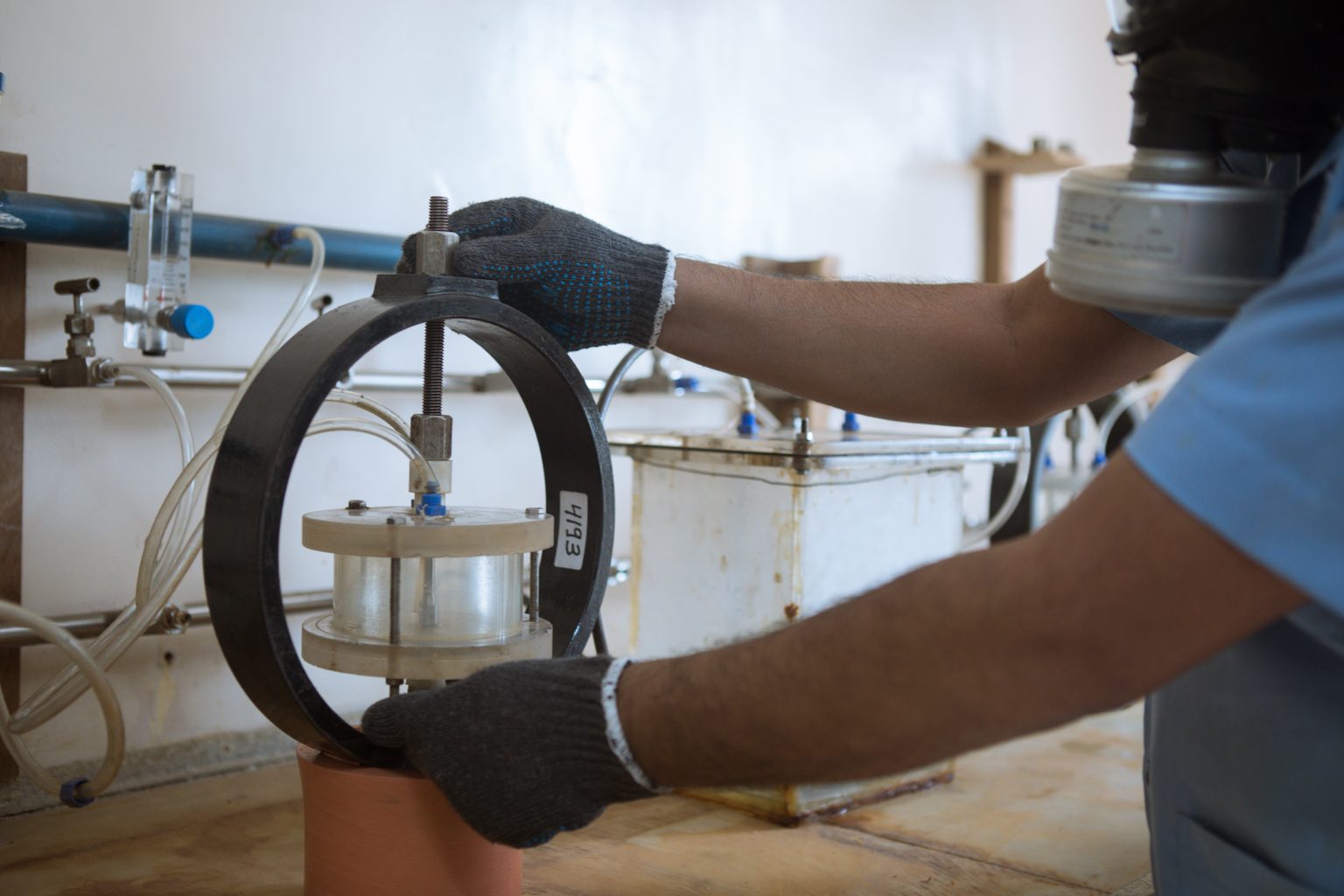
The four-point bend condition carried its own detail: stress applied with a dial gauge to 80 per cent of actual yield strength, specimens 15 mm wide by 5 mm maximum thickness by 120 mm long, and a fixture with a 100 mm outer span and a 50 mm inner span.
Two further clauses governed the work, and they matter more than any of the parameters above:
- The test parameters were to be adjusted in line with the operator's comments, and the test procedure was to be submitted to the operator for review and approval.
- Test reports were to be issued within five working days of test completion.
The two conditions that cannot both hold
The four-point bend line specified atmospheric pressure and an H2S partial pressure of 5 bar in the same sentence. At a total pressure of one atmosphere, no component of the gas can have a partial pressure of five bar. One of the two is wrong, and which one is wrong changes the test completely.
- If the intent is the ambient-pressure test, the exposure is a NACE TM0177 four-point bend with the solution saturated with H2S at one atmosphere, in a glass or plastic cell at ambient pressure. That is the test the standard describes and the one the 720-hour duration belongs to.
- If the intent is 5 bar, the exposure is a pressurised autoclave test. Different vessel, different gas handling, different relief and interlock arrangements, a different safety case, and a different acceptance basis.
This is not a criticism of the buyer. A line-pipe specification typically travels from the operator to the EPC contractor to the mill to the laboratory, and each transcription is an opportunity for a unit or a qualifier to be dropped. The point is where the error gets caught. Caught in the procedure, it costs an email. Caught at hour 720, it costs a month and a set of specimens that have to be re-machined from pipe the mill may no longer have.
"A purchase order is not a test procedure. When two conditions on the same line cannot both hold, the honest thing is to say so before the specimen goes into the cell, not after seven hundred and twenty hours."
Why the procedure is the first deliverable
The order made this explicit: the procedure goes to the operator for approval, and the parameters follow the operator's comments. So the first thing that leaves the laboratory is not data. It is a written procedure naming the solution, the gas composition and partial pressure, the total pressure, the temperature tolerance, the stress level and how it is applied and verified, the specimen geometry, the fixture spans, the duration, and the evaluation method.
An approved procedure does three things at once. It closes the contradiction above in writing, with the operator's signature on the resolution rather than the laboratory's assumption. It fixes the acceptance criteria before there is a result to argue about. And it gives the mill a document it can put in front of its own customer, which is usually what the mill actually needs.
What 720 hours means
The SSC exposure runs for 720 hours because NACE TM0177 says so. Thirty days is not a scheduling preference; it is the test. A shortened exposure is a different experiment that happens to use the same fixture, and a report that presents it as a TM0177 result is not defensible in front of an operator's materials engineer.
That has a practical consequence for a mill planning a shipment. The qualification clock starts when the procedure is approved and the specimens are machined, not when the purchase order is signed. Thirty days of exposure, plus specimen preparation, plus evaluation and reporting, is the floor. Building that into the delivery programme is cheaper than discovering it.
What the work requires from the laboratory
- Accreditation that the operator recognises. The work runs under TCR's NABL ISO/IEC 17025:2017 accreditation, certificate NABLT0726MH18640, whose reports are accepted in more than 90 economies under the ILAC mutual recognition arrangement.
- A gas train and the discipline to run it. H2S at working concentrations is lethal, and a 720-hour exposure means the containment, the scrubbing and the monitoring have to hold for thirty days without attention lapsing.
- Fixtures in the specified geometry, and a machine shop. The four-point bend spans are specified to the millimetre. TCR machines its own specimens at Mahape, Navi Mumbai, which is what makes a non-standard width or thickness a scheduling question rather than a refusal.
- Standing on the operator's approved list. TCR's laboratory is registered on the Oman Joint Supplier Registration System, supplier code IN100928, and the certificate is published in the document library.
Related reading on this site
- SSC with four-point bend as per NACE TM0177 and ASTM G39, on the fixtures and specimen sizes themselves.
- Why PDO's vendors trust TCR Engineering for critical carbon steel line pipe testing, on PDO SP-2347 as a specification.
- OQGN and PDO specification testing, on the wider Oman qualification route including CTOD.
- Sour gas corrosion testing in India, on the laboratory's scope.
Neither the test results nor the commercial terms of the order are published here. What is published is the shape of the problem, because it recurs on every sour-service qualification that crosses three organisations before it reaches a laboratory.
Continue reading
Frequently asked questions
What is the difference between HIC and SSC testing?
Hydrogen induced cracking testing per NACE TM0284 exposes unstressed specimens to a sour environment and looks for internal cracking driven by hydrogen alone. Sulphide stress cracking testing per NACE TM0177 holds the specimen under an applied stress, typically 80 per cent of actual yield strength, and looks for cracking driven by hydrogen and stress together.
How long does a four-point bend SSC test take?
The NACE TM0177 exposure is 720 hours, which is 30 days, and it is not shortened. Specimen machining, procedure approval, evaluation and reporting sit on top of that, so a realistic qualification window from purchase order to report is six to eight weeks.
Why does the test procedure need the operator's approval?
Because the operator, not the mill and not the laboratory, owns the acceptance criteria. Specifications such as PDO SP-2347 supplement API 5L with additional sour-service requirements, and approving the procedure before testing fixes the environment, the stress level and the evaluation method while they can still be changed.
Can TCR run sour-service tests at pressures above one atmosphere?
Yes. TCR's Navi Mumbai laboratory runs both ambient-pressure NACE TM0177 and TM0284 exposures and pressurised autoclave exposures. Which one applies is a question the approved procedure answers, and it is worth settling before specimens are machined.
Does TCR machine the specimens as well?
Yes. Specimens are machined in TCR's own machine shop at Mahape, Navi Mumbai, which is why a non-standard bend specimen width or thickness is a scheduling question rather than a refusal.
Is TCR registered to supply the Oman oil and gas industry?
Yes. TCR Engineering Services Pvt. Ltd. is registered on the Joint Supplier Registration System operated for the Ministry of Energy and Minerals, supplier code IN100928, under certificate JSRSIN3061316184004 valid to 8 August 2028.