
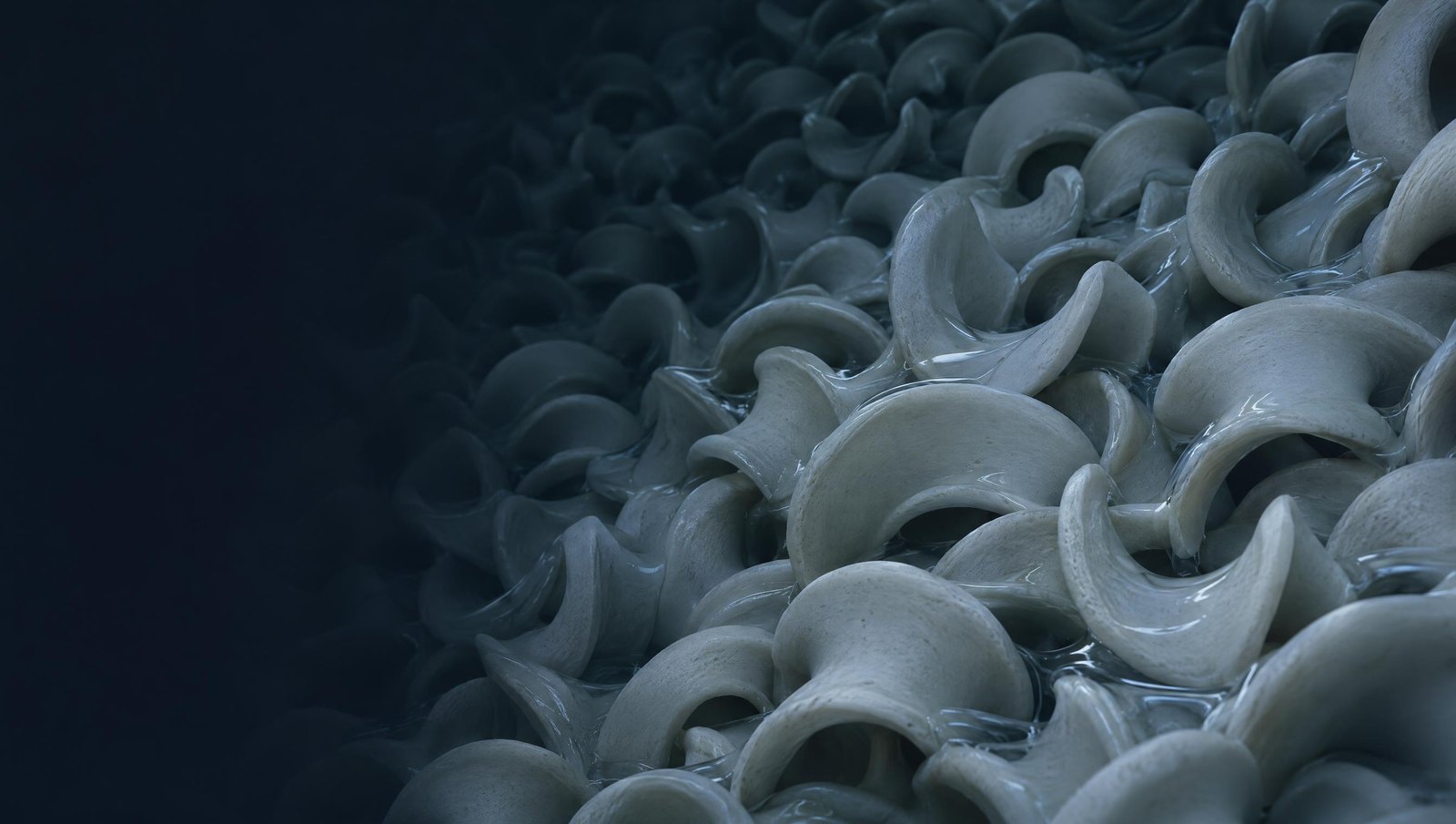
TCR Engineering tests ceramic saddles and other ceramic tower packings to IS 7087:1979 at its Mahape laboratory in Navi Mumbai: water absorption, acid resistance, crushing strength, total iron as Fe2O3 and full oxide composition by wet chemical analysis. The work is standard laboratory testing, reported outside the scope of NABL certificate NABLT0726MH18640.
- What is tested: Intalox and Berl saddles, Raschig rings, cylindrical and honeycomb packings in chemical-resistant ceramic.
- Standard: IS 7087:1979, Specification for ceramic tower packings (first revision, reaffirmed 2017), and customer specifications built on it; ASTM C515 for buyers who specify the American standard.
- Tests: water absorption, acid resistance, crushing strength, total iron as Fe2O3, and SiO2, Al2O3, Fe2O3, CaO and MgO by wet chemical analysis.
- Who asks: packing manufacturers releasing a batch, traders qualifying a supplier, and plant owners checking a delivery before it goes into a tower.
- Where: the chemical analysis bench at Mahape, with the physical tests run alongside.
- Accreditation: IS 7087 is not on NABL certificate NABLT0726MH18640. Results are issued as standard laboratory testing, with the method and conditions stated on the report.
Four ways a saddle fails a tower
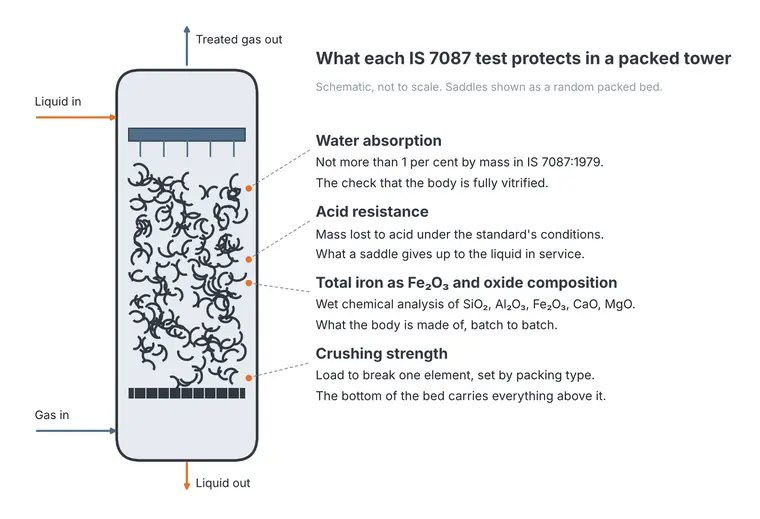
A packed tower asks very little of a saddle and asks it for years. The saddle has to stay the same shape, stay the same mass and stay out of the chemistry. It fails a tower in one of four ways, and IS 7087 has a test aimed at each.
It can soak up liquid, because the body was under-fired and left porous. It can dissolve slowly into the acid or solvent running over it. It can break under the weight of the bed above it, or during charging, and the fragments then pack the voids and raise the pressure drop. Or it can carry iron and other soluble oxides that leach into a product stream that was never supposed to see them.
| Failure in service | IS 7087 test that guards against it | What the result tells the buyer |
|---|---|---|
| Liquid held in the body, spalling, slow attack from inside | Water absorption | Whether the body is properly vitrified |
| Loss of mass and shape in acid service | Acid resistance | How much of the saddle the acid can remove under the standard's conditions |
| Breakage under bed load or during charging | Crushing strength | Load one element carries before it breaks, by type |
| Iron and other oxides leaching into the process | Total iron as Fe2O3, oxide analysis | What the ceramic body is made of, batch to batch |
Water absorption is the vitrification test, and IS 7087 made it pass or fail
Water absorption measures how much water a dried packing element takes up under the conditions the standard prescribes, as a percentage of its dry mass. It reads porosity, and porosity reads firing. A fully vitrified porcelain or stoneware body has its pores closed by glass; an under-fired one does not, and the open pores are where liquid enters the body and where attack starts from the inside.
IS 7087:1979 sets the limit at not more than 1 per cent by mass. The more useful fact is in its foreword. The first edition carried a second grade with water absorption above 1 per cent; the 1979 revision deleted it and kept a single grade. A buyer in India does not choose between a dense packing and a porous one under IS 7087. A packing that absorbs more than 1 per cent is simply not an IS 7087 packing.
That makes water absorption the cheapest early warning in the whole suite. A kiln that ran cool shows up here first, before the acid test has finished and long before the tower shows it.
Acid resistance is a measured mass loss, not a material claim
"Acid-resistant ceramic" is a description. Acid resistance under IS 7087 is a measurement: specimens are exposed to acid under the conditions the standard prescribes, and the mass they lose is reported against the limit. The result belongs to that acid, that concentration and that duration. It is a quality-control comparison between batches and suppliers, not a prediction of service life in a particular tower.
That boundary matters most in sulphuric acid plants, where packed towers dry air and absorb sulphur trioxide in strong acid, and in scrubbers and acid recovery units across chemicals, fertilisers and refining and petrochemicals. A plant that runs hot or at an unusual concentration can ask for an additional exposure at its own conditions. That is reported as a test to the customer's procedure, alongside the IS 7087 result rather than in place of it.
Crushing strength protects the bottom of the bed
A random bed is loaded unevenly. The elements at the bottom carry the weight of everything above them, plus the liquid hold-up, plus the shock of charging, and a broken saddle does more harm than a missing one because its fragments fill the voids. IS 7087 therefore sets crushing strength by packing type; its 1979 revision raised the values for Types 1, 2, 3 and 4 on the basis of investigations it cites.
The test loads a single element to fracture and records the load. A low result on one size from one kiln run is a sorting decision. A low result across a batch is a body or firing problem that the water absorption result will usually have hinted at already.
Iron and oxide composition: what the body is made of
Physical tests say whether the body was made well. Chemistry says what it was made from. TCR determines total iron, expressed as Fe2O3, and the oxide composition of the ceramic by wet chemical analysis:
- SiO2: the glass-forming backbone of a porcelain or stoneware body.
- Al2O3: the refractory oxide that carries strength and chemical resistance.
- Fe2O3: iron from the clay and from contamination during processing; the oxide a buyer most often specifies a ceiling for.
- CaO and MgO: fluxing oxides that help vitrification and change how the body behaves in acid.
- Other oxides: added where the customer's specification names them.
Wet chemistry is the classical route for oxide analysis of ceramics: gravimetric silica, then the remaining oxides by titrimetric and instrumental finish. TCR's WDXRF spectrometer at Mahape can screen a ceramic body quickly, and a disputed or specification-critical figure still goes to the wet bench. TCR keeps a dedicated classical wet chemistry department for exactly that purpose.
What to send, and what the report carries
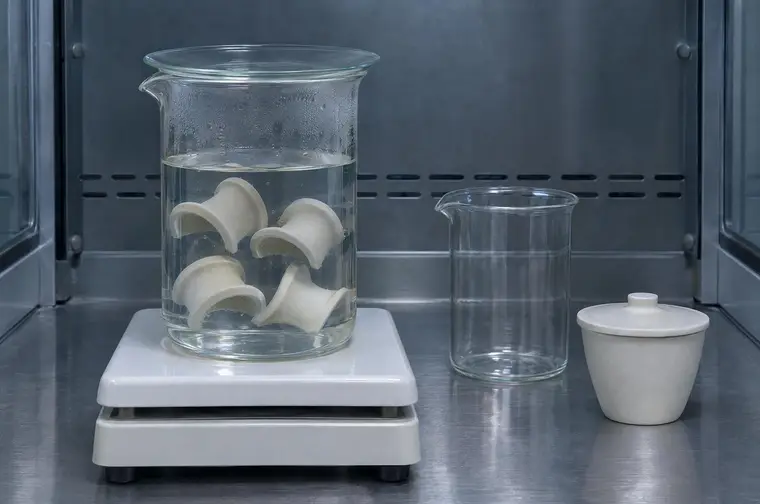
A complete test needs enough elements of one type and size to run every test without re-using a specimen, drawn from the lot rather than picked from the top of a bag. Mixed sizes in one sample give results that cannot be read against the crushing strength requirement for that type.
- The sample: elements of a single type and nominal size, identified by lot, with the quantity confirmed in the quotation.
- The specification: IS 7087 alone, ASTM C515, or the purchase specification, with any customer limits stated.
- The tests wanted: the full IS 7087 suite, or the physical tests only, or chemistry only.
- Service conditions, if an additional acid exposure at plant conditions is wanted.
The report states the standard and clause for each result, the conditions of each test, the reporting basis for each oxide, and the requirement it is compared with.
From the chemistry bench
Aarti Bhawari, Senior Chemist in Chemical Analysis at TCR Engineering, Mahape, runs the oxide work on ceramic packings.
"A saddle looks the same whether it was fired properly or not, so the first number I look at is water absorption. If a batch is close to the 1 per cent line, I expect to see it again in the acid result, and the oxide analysis usually tells us why. The chemistry is not there to fill a column on the report. It is there so that when a buyer compares two suppliers, or this batch with the last one, they are comparing what the ceramic is actually made of."
Where this sits in TCR's laboratory practice
Ceramic tower packing testing runs on the chemical analysis bench at Mahape, the same bench that analyses ceramics, glass, refractories, minerals and slags by wet chemistry, ICP, AAS and XRF. IS 7087 does not appear in the annexure to NABL certificate NABLT0726MH18640, which is published in full on the quality and accreditation page, so the tests are reported as standard laboratory testing with method and conditions stated. Schedule and sample quantity are confirmed in the quotation.
For a packing manufacturer, the practical sequence is to test every new body or kiln change against the full suite, then hold water absorption and iron as routine batch checks. For a plant buyer, a delivery-acceptance test on the lot that will actually go into the tower is the cheapest insurance against a repacking shutdown. Request a quote with the specification and the quantity on hand.
Frequently asked questions
What is IS 7087?
IS 7087:1979 is the Indian Standard specification for ceramic tower packings used in absorption towers, refining columns and scrubbers in chemical plants. It prescribes the requirements and the methods of sampling and test, including water absorption, acid resistance and crushing strength. It was reaffirmed in 2017.
What is the water absorption limit for ceramic tower packings in IS 7087?
Not more than 1 per cent by mass, tested by the method in the standard's Appendix A. The 1979 revision deleted the earlier second grade with water absorption above 1 per cent, so the standard now has a single grade.
Which tests does TCR Engineering run on ceramic saddles?
Water absorption, acid resistance and crushing strength, total iron content expressed as Fe2O3, and the oxide composition, covering SiO2, Al2O3, Fe2O3, CaO, MgO and other oxides the customer specifies, by wet chemical analysis at the Mahape laboratory in Navi Mumbai.
Is ceramic tower packing testing on TCR Engineering's NABL scope?
No. IS 7087 does not appear in the annexure to NABL certificate NABLT0726MH18640. The tests are performed and reported as standard laboratory testing, with the method and test conditions stated on the report.
Does an acid resistance result predict how long a saddle will last in a tower?
No. The result is the mass lost under the acid, concentration and duration the standard prescribes. It compares batches and suppliers on a common basis. A plant with unusual conditions can ask for an additional exposure to its own procedure, reported alongside the IS 7087 result.
Why test iron content in a ceramic packing?
Iron comes from the clay and from contamination during processing, and it is one of the oxides strong acid can leach from the body into the process stream. Total iron expressed as Fe2O3 is the figure purchase specifications most often limit, and tracking it batch to batch shows when the raw material or the process has changed.