

TCR Engineering analyses high-purity magnesium oxide powder in the 97 to 99.9 per cent grades at its Mahape laboratory in Navi Mumbai: MgO content, the oxide impurities SiO2, CaO, Fe2O3 and Al2O3, and loss on ignition, by wet chemical and instrumental methods. The work is standard laboratory testing, reported outside the scope of NABL certificate NABLT0726MH18640.
- Material: magnesium oxide powder from 97 to 99.9 per cent MgO, calcined or electrically fused.
- Parameters: MgO, SiO2, CaO, Fe2O3, Al2O3 and loss on ignition, with further oxides or trace elements where the specification names them.
- Methods: wet chemical analysis, with ICP and AAS finishes where the concentration calls for them.
- Specification in the thermocouple trade: ASTM E1652, for MgO and Al2O3 powders and crushable insulators used in base metal and noble metal thermocouples and metal-sheathed platinum resistance thermometers.
- Who asks: MgO producers and traders, makers of mineral-insulated cable, thermocouples and tubular heaters, and refractory and ceramic manufacturers.
- Accreditation: these determinations on MgO powder are not on NABL certificate NABLT0726MH18640. Results are issued as standard laboratory testing, with method and reporting basis stated.
A purity figure is only as complete as its impurity list
Most purity certificates for magnesia do not measure MgO at all. They measure four or five impurities, add them up and subtract the total from 100. That is a legitimate method when the impurity list is complete. When it is not, every element nobody looked for is quietly reported as magnesium oxide.
The difference rarely matters at 97 per cent. At 99.9 per cent the whole specification is the impurities: one tenth of one per cent is the entire allowance, and a single unmeasured contaminant can consume it without the certificate showing anything wrong.
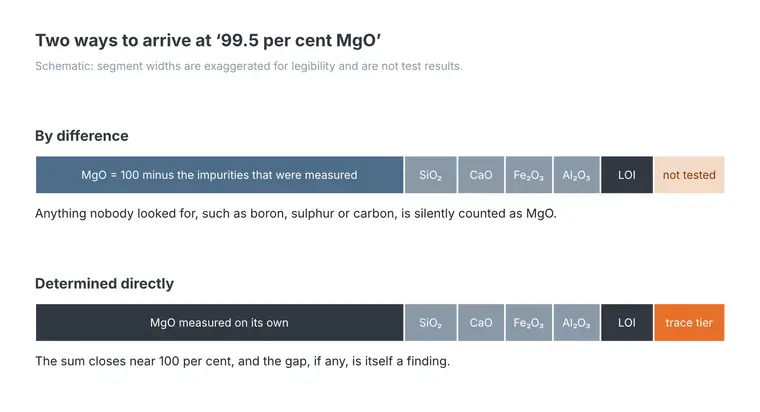
TCR determines MgO in its own right and the impurities alongside it, so the analysis closes. A total near 100 per cent confirms the impurity list was complete. A shortfall is a finding, and the report says so rather than absorbing it into the MgO figure.
| Parameter | Why it is on the list | What a high value usually means |
|---|---|---|
| MgO | The principal oxide and the purity claim itself | Measured directly, not by difference |
| SiO2 | Silica from the raw mineral or the process | A contaminant insulation and refractory grades limit closely |
| CaO | Calcium carried over from dolomitic or limestone sources | Raw material variation between lots |
| Fe2O3 | Iron from the mineral or from milling and handling | Contamination during grinding, or a change of source |
| Al2O3 | Alumina from clays or from the process | Raw material variation or process contamination |
| Loss on ignition | Mass lost on heating under specified conditions | Moisture and carbon dioxide taken up in storage |
Loss on ignition: magnesia takes up air
Magnesium oxide is reactive towards the atmosphere. Given time and humidity, it takes up moisture to form magnesium hydroxide and carbon dioxide to form carbonate, and the powder gains mass that is not magnesia. Loss on ignition measures that pick-up by heating the sample under specified conditions and weighing what is driven off.
Two consequences follow for anyone writing a purchase specification:
- State the basis. MgO reported on the as-received powder and MgO reported on the ignited basis are different numbers for the same material. A specification that does not say which one it means invites a dispute.
- Sample from sealed stock. A sample bag left open in a humid store for a week is a different material from the lot it came from. LOI on the sample tells you only about the sample.
In mineral-insulated cable, where the powder is the only thing between a conductor and an earthed sheath, moisture in the magnesia is a direct threat to insulation resistance. That is why the cable and heater trades treat LOI as a functional parameter rather than a formality.
What ASTM E1652 covers, and what it does not
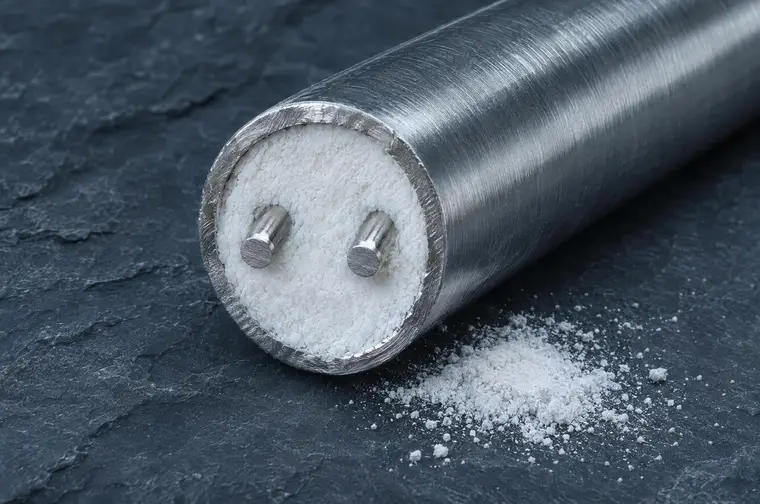
ASTM E1652 is the specification for magnesium oxide and aluminium oxide powders and crushable insulators used in the manufacture of base metal thermocouples, metal-sheathed platinum resistance thermometers and noble metal thermocouples, and their cables. It classifies MgO by type, including Type 1, Type 1P and Type 2, each with its own chemical requirements, and it covers wet chemical, fusion and quantitative analysis, density determination and the breaking force of crushable insulators.
Its scope is the point. E1652 is written for insulation in temperature-sensing devices. It is not a general specification for commercial, refractory or chemical-grade magnesia, and quoting it on a refractory order borrows limits that were set for a different job. Where a buyer of non-sensor MgO wants an E1652-style analysis, TCR reports the parameters against the customer's own limits and says so.
E1652 also asks more of an analysis than a major-oxide method can give. As set out in TCR's note on its WDXRF spectrometer, the specification asks for 0.01 mass per cent sensitivity on MgO, Al2O3, CaO, SiO2 and ZrO2, and 0.0001 mass per cent on boron, cadmium, sulphur, carbon and iron oxide. The majors are routine. The trace tier is ICP work, with sulphur and carbon by combustion, and it is the tier that separates a sensor-grade powder from one that only looks clean on a five-oxide certificate.
How TCR runs the analysis
The analysis follows the same order every time, because each step depends on the one before.
- Sample preparation. Representative splitting of the lot sample, with the as-received portion for LOI taken before anything else is done to it.
- Loss on ignition. Heating under specified conditions and weighing, so the reporting basis for every other result is fixed.
- MgO determination. By a validated chemical procedure, as a measured figure.
- Impurity analysis. SiO2, CaO, Fe2O3 and Al2O3 by wet chemical methods with instrumental finishes where the concentration is low, plus any further oxides the specification lists.
- Closure and evaluation. The results are summed, the total is checked, and each value is compared with the customer's specification or the stated standard requirement.
From the chemistry bench
Aarti Bhawari, Senior Chemist in Chemical Analysis at TCR Engineering, Mahape, runs MgO analyses on the chemical analysis bench.
"With a 99.9 per cent powder, the MgO number is the least interesting thing on the report. The question is whether the impurities that were measured are all the impurities there are. So we measure MgO in its own right and make the analysis close. If the total comes up short, the customer needs to know that, not a purity figure that quietly includes whatever we did not look for. And we always fix the loss on ignition first, because magnesia that has been sitting in a humid store is not the same material as the lot it was drawn from."
What to send, and where this sits
Send the powder in a sealed, airtight container, drawn from the lot rather than from an opened bag, with the grade, the specification and the reporting basis wanted (as received or ignited). Name any trace elements the end use is sensitive to. Sample quantity is confirmed in the quotation.
High-purity MgO analysis runs on the same Mahape bench that analyses ceramics, glass, refractories, minerals and slags by wet chemistry, ICP, AAS and XRF. MgO powder as a material does not appear in the annexure to NABL certificate NABLT0726MH18640, which is published in full on the quality and accreditation page, so these results are issued as standard laboratory testing with method and basis stated. For makers in power generation, steel and metals and chemicals, request a quote with the grade and the specification.
Frequently asked questions
How is the purity of high-purity magnesium oxide determined?
Either by difference, as 100 per cent minus the measured impurities, or by determining MgO directly alongside the impurities so the analysis closes. TCR measures MgO in its own right, together with SiO2, CaO, Fe2O3, Al2O3 and loss on ignition, and reports any shortfall in the total rather than counting it as MgO.
Which impurities are tested in MgO powder?
Silicon dioxide, calcium oxide, ferric oxide and aluminium oxide as standard, with loss on ignition. Further oxides or trace elements are added where the customer's specification or the end use names them, for example boron, sulphur or carbon for thermocouple insulation grades.
What does ASTM E1652 cover?
ASTM E1652 specifies magnesium oxide and aluminium oxide powders and crushable insulators used to make base metal thermocouples, metal-sheathed platinum resistance thermometers and noble metal thermocouples. It classifies MgO by type, such as Type 1, Type 1P and Type 2, with chemical requirements for each. It is not a general specification for refractory or chemical-grade magnesia.
Why does loss on ignition matter for magnesium oxide?
Magnesium oxide takes up moisture and carbon dioxide from air, forming hydroxide and carbonate. Loss on ignition measures that pick-up. It fixes whether results are on an as-received or ignited basis, and in mineral-insulated cable moisture in the magnesia directly affects insulation resistance.
Is MgO powder testing on TCR Engineering's NABL scope?
No. Magnesium oxide powder as a material is not in the annexure to NABL certificate NABLT0726MH18640. The analysis is performed and reported as standard laboratory testing, with the method and reporting basis stated on the report.
How should an MgO sample be sent for analysis?
In a sealed, airtight container, drawn from the lot rather than from a bag already opened, with the grade, the specification and the reporting basis stated. Magnesia exposed to humid air changes in mass, so a poorly stored sample describes the sample, not the lot.