
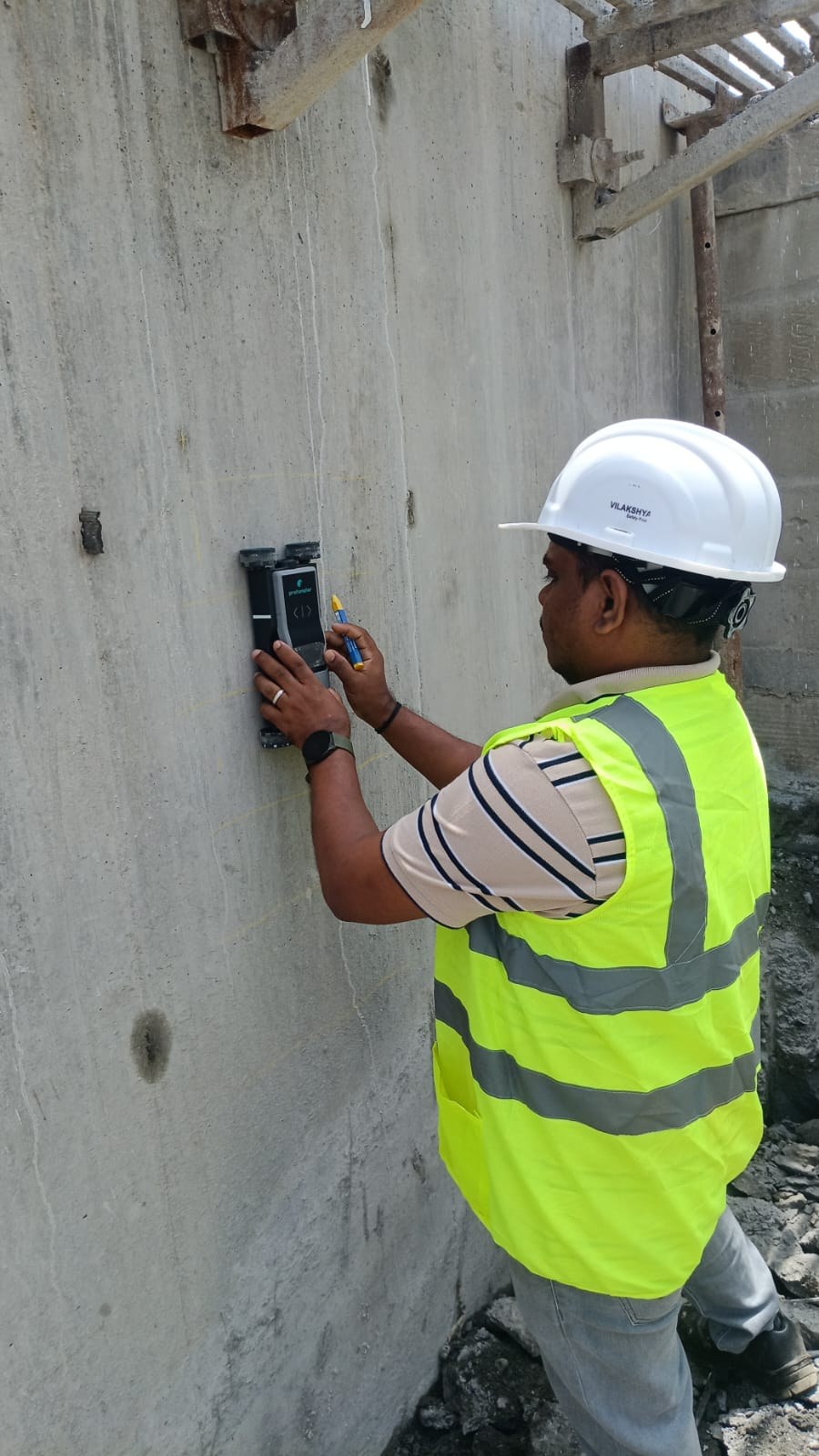
Non-destructive testing of concrete does not measure strength. It measures surface hardness, wave velocity, electrochemical potential and the depth of a chemical front, and each of those answers exactly one question about the structure. TCR Engineering Services Pvt. Ltd., a NABL ISO/IEC 17025:2017 accredited laboratory operating since 1973, has completed 1,200+ structural audits and inspected 500+ bridges, and the single most common reason a concrete investigation has to be repeated is that the wrong test was asked to answer a question it cannot answer.
The useful skill is not knowing how a rebound hammer works. It is knowing what its number is not.
What is NDT testing in concrete?
Non-destructive testing of concrete is a set of site methods that assess a hardened concrete structure without removing material from it. In Indian practice the working set is six: rebound hammer, ultrasonic pulse velocity, half-cell potential, carbonation depth, cover meter survey and ground penetrating radar, with core extraction sitting behind them as the destructive reference.
Each one is an indirect measurement. The instrument reads a physical property that correlates with the property you actually care about, and the correlation is the weak link in every one of them. That is why an NDT campaign is designed as a set rather than ordered as a single test.
- Rebound hammer: surface hardness of the outer few millimetres.
- Ultrasonic pulse velocity (UPV): the transit time of a compression wave through the section, which reports uniformity and the presence of internal discontinuity.
- Half-cell potential: the electrochemical potential of the embedded steel, which reports the probability that corrosion is active.
- Carbonation depth: how far the pH front has moved into the cover, which reports whether the steel has lost its passive protection.
- Cover meter survey and rebar scanning: the position of, and the depth to, the reinforcement.
- Core extraction: the only one of the set that produces a strength.
Which concrete NDT test answers which question?
Start from the question, not from the instrument. A concrete investigation usually asks one of five things, and each of those five has one method that answers it and several that do not.
| The question being asked | The method that answers it | The standard it runs to | What the result actually is |
|---|---|---|---|
| Is the concrete uniform, and is there anything inside the section? | Ultrasonic pulse velocity | IS 516 (Part 5/Sec 1) | A wave velocity, read as a uniformity classification and a discontinuity indication |
| Is the surface layer sound, and are two pours consistent with each other? | Rebound hammer | IS 516 (Part 5/Sec 4), IS 516 (Part 5/Sec 4):2020 | A rebound index for the surface zone, comparative before it is absolute |
| Is the reinforcement corroding right now? | Half-cell potential | ASTM C876-22b, IS 516 (Part 5/Sec 2) | A potential map read as a probability of active corrosion |
| Has the cover lost its ability to protect the steel? | Carbonation depth | BS EN 14630, IS 516 (Part 5/Sec 3) | A depth of the carbonation front, compared against the measured cover |
| Where is the steel, and how much cover is over it? | Cover meter survey, GPR | BS 1881-204 for cover meter | A position and a cover depth, and nothing about the steel's condition |
| What is the in-situ compressive strength? | Core extraction and test | IS 516 (Part 4) | A strength, from a specimen that no longer exists in the structure |
Read the table by its last column. Only one row returns a strength, and that row is the destructive one.
What can each of these tests not tell you?
This is the part that decides whether an investigation holds up. Every method in the set has a boundary, and reports fail scrutiny at the boundary rather than in the measurement.
- Rebound hammer gives surface hardness, not strength. The index reads the outer skin. Carbonation, surface moisture, finish, aggregate at the impact point and the age of the concrete all move it, and every one of them moves it in the direction of a higher number on older concrete. A rebound survey is a comparison instrument for finding the weakest member in a set. Converting its index into a strength for a structural decision is the most common defect in Indian concrete reporting.
- UPV gives uniformity, not strength. Velocity responds to density, moisture content, reinforcement in the path and any void or crack the wave has to travel around. Two members of the same grade can return different velocities for reasons that have nothing to do with strength, and a member with honeycombing can return a velocity that looks acceptable if the path missed it. UPV tells you where to look next.
- Half-cell potential gives corrosion probability, not section loss. The map says where the steel is likely to be actively corroding. It does not say how much steel is left, how long it has been going on, or whether the member has lost capacity. A high-probability zone is an instruction to open up and measure, not a conclusion.
- Carbonation depth gives the position of the pH front, not remaining life. It tells you whether the passive layer at the steel has been lost where you tested. Turning that into a remaining life requires the cover measured at the same locations, the exposure condition, and a model, and the answer is only as good as the cover survey behind it.
- Cover meter survey and GPR give geometry, not condition. They locate the bar and measure the cover over it. They say nothing about whether the bar is sound.
- Core extraction gives strength, and it is destructive. It is the only member of the set that produces the number a structural check needs, and taking it costs a hole in the member, so the NDT set exists mainly to decide where the cores should go.
The engineering discipline is to use the non-destructive set to build a hypothesis and locate the worst zone, then to spend the cores confirming it. Reversing that order, coring first and then testing around it, spends the destructive budget before the evidence has been gathered.
Which of these tests sit inside TCR's NABL scope, and which do not?
Four of the six site methods are on TCR Engineering's NABL ISO/IEC 17025:2017 certificate and two are not, and that boundary decides which pages of a report may carry the accreditation symbol. This is a fact worth checking before the report is written rather than after a client or an auditor asks.
Accredited site methods under certificate NABLT0726MH18640, which carries 1,483 scope items in total, are carbonation testing to BS EN 14630 and IS 516 (Part 5/Sec 3), half-cell potential testing to ASTM C876-22b and IS 516 (Part 5/Sec 2), rebound hammer testing to IS 516 (Part 5/Sec 4):2020 and IS 516 (Part 5/Sec 4), and ultrasonic pulse velocity testing to IS 516 (Part 5/Sec 1). Core and cube compressive strength are accredited in the laboratory to IS 516 (Part 4) and IS 516 (Part 1/Sec 1).
Cover meter survey to BS 1881-204 and GPR rebar scanning are not on that certificate. TCR performs both, and both are reported as they are: measurement made to the named method, outside the accredited scope. An accreditation claim that the certificate does not carry is the failure mode that costs a laboratory its report, and stating the boundary in the report is cheaper than defending it later.
Two details in that list are worth a second look, because most Indian concrete reports still cite the older route by habit:
- The accredited route for ultrasonic pulse velocity is IS 516 (Part 5/Sec 1), the hardened-concrete NDT standard, not IS 516 (Part 5/Sec 1):2018.
- The accredited route for rebound hammer runs to both IS 516 (Part 5/Sec 4):2020 and IS 516 (Part 5/Sec 4).
Anyone can check this rather than take it on trust: NABL publishes its own view of certificate NABLT0726MH18640.
Why do we test concrete for 7 days, 14 days and 28 days?
Because 28 days is the age at which the concrete is judged, and the earlier breaks exist to tell you before then whether it is going to pass. IS 456:2000 is explicit that in all cases the 28-day strength alone is the criterion for acceptance or rejection of the concrete; the 7-day and 14-day results are process control, not acceptance.
The reason 28 days is the reference is the hydration curve of ordinary Portland cement. The strength gain is steep in the first week, still material in the second and third, and slow enough after four weeks that a fixed age gives a repeatable basis for comparison across mixes, sites and laboratories. The number is a convention chosen because it is stable, not because the concrete stops gaining strength.
What each break is for in practice:
- 7 days. The early warning. A 7-day result well below the trend for that mix is a reason to check batching, water content and curing while the pour behind it can still be changed. It cannot be used to accept or reject.
- 14 days. Confirmation of the trend where the mix, the cement type or a supplementary cementitious material makes the 7-day-to-28-day relationship less predictable. Blended cements gain later, and a 7-day figure alone can be read as a failure that the 28-day break does not support.
- 28 days. The acceptance test, and the only one of the three that carries a decision under IS 456.
If the 28-day cubes fail, the argument moves off the cubes and onto the structure, which is where the NDT set and core testing come in. Cubes describe the concrete that was delivered. Cores and NDT describe the concrete that is standing there now, after placement, compaction and curing have had their effect.
When does a core become unavoidable?
A core becomes unavoidable the moment a decision needs an in-situ strength rather than an indication. No combination of rebound hammer and UPV readings substitutes for it, however many points are taken.
In practice there are four triggers: the 28-day cubes have failed and the structure has to be assessed as built; the NDT set has found a zone that is materially different from the rest of the member; the structure is being assessed for a change of use or an added load with no reliable construction records; or a regulator, an insurer or a court will read the report and an indication will not carry the weight. Everything before those triggers is the NDT set doing its actual job, which is to make sure the cores are taken in the right place and that there are as few of them as the question allows.
What belongs in a concrete NDT report that has to survive scrutiny?
A defensible concrete NDT report states the method, the standard, the instrument and its calibration traceability, the test locations, the environmental conditions at the time of test, and the limits of what each measurement supports. It separates measurement from interpretation, and it never presents a correlated value as a measured one.
The lines that most often decide whether a report survives review:
- The standard and its part and section, written in full, for every method used.
- Which results fall inside the accredited scope and which do not, stated on the report and not left to the reader.
- Test locations recorded so that a second party can return to them.
- Surface condition and preparation, because they move the rebound and the potential.
- Measured cover reported alongside carbonation depth, since neither means much alone.
- The uncertainty, or the acknowledged basis, for any value carried into a structural decision.
- A recommendation that names what would settle the remaining question, usually where the cores go.
Where this goes next
The four site methods above each have their own page on this site, and the service that carries the subsurface work is GPR, UPV and Subsurface Mapping. For the individual methods:
- Detecting rebar corrosion with half-cell potential testing
- Ultrasonic pulse velocity (UPV) testing
- Rebar cover testing in India
- NABL accredited concrete cube compressive strength testing, Mumbai
- Rebar Cover Meter Survey per BS 1881-204
- Structural Audit under Section 353B of the Mumbai Municipal Corporation Act 1888
- Concrete, Cement and Aggregates