
TCR Advanced Engineering Pvt. Ltd., the TCR group's Vadodara company, carries out acoustic emission testing (AET) of above-ground storage tanks and pressure vessels, including new FRP pressure vessels under hydrostatic pressurisation, for clients across India. Reports are issued by TCR Advanced, which holds NABL certificate TC-6739; acoustic emission itself is not a NABL accredited test.
- Entity: TCR Advanced Engineering Pvt. Ltd., Vadodara, part of the TCR group.
- What AE finds: active sources under stimulus: crack initiation, crack propagation including fatigue, active corrosion and growing pitting.
- What AE does not do: size a defect, give its shape or depth, or find a defect that is not active under the applied load.
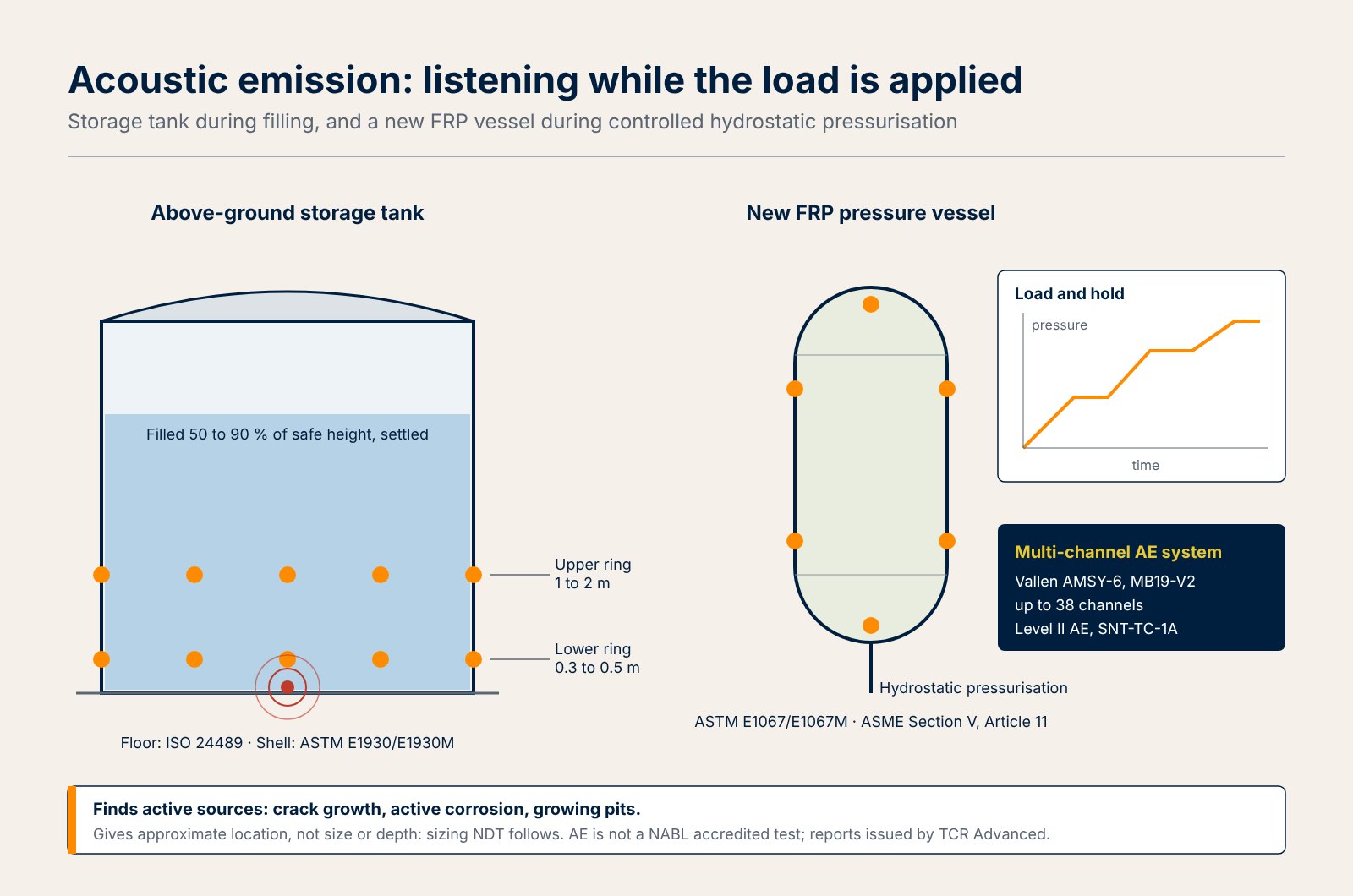
- Storage tanks: floor to ISO 24489:2024, shell during filling to ASTM E1930/E1930M-25; findings feed the API 653 inspection.
- FRP vessels: examination during controlled hydrostatic pressurisation to ASTM E1067/E1067M-25 and/or ASME Boiler and Pressure Vessel Code Section V, Article 11.
- Instrument: Vallen AMSY-6 in an MB19-V2 chassis, up to 38 channels.
- Personnel: Level II AE technicians qualified to SNT-TC-1A.
- Accreditation position: reports issued by TCR Advanced (NABL TC-6739); AE is outside the accredited scope.
What acoustic emission actually listens for
Acoustic emission is a passive method. Sensors on the surface of a component listen for the stress waves released inside the material when something changes: a crack extends, a fatigue crack grows a step, a corrosion process breaks down a surface, a pit deepens. The method does not send energy in and wait for an echo, as ultrasonics does. It waits for the component to report on itself.
That has one consequence that governs everything else: the component must be stressed during the test. A defect that is stable under the applied load makes no sound, and AE cannot see it. The stimulus is whatever loads the asset: filling a tank, pressurising a vessel, holding at pressure. No load, no data.
The sources AE detects under that stimulus are:
- active crack initiation;
- active crack propagation, including fatigue cracking;
- active corrosion;
- growing pitting corrosion.
Its limitations should be stated as plainly as its strengths, because an owner who expects more from it will plan badly:
| AE tells you | AE does not tell you |
|---|---|
| That a source is active under this load, now | Anything about a defect that is not active under the load applied |
| The approximate location of the source | The size, shape or depth of the defect |
| Which areas of a large asset need attention first | A wall thickness or a remaining-life figure on its own |
Results are also influenced by background noise, which is why so much of a tank test is about silencing the tank before the sensors go on. Where AE locates an active source, the follow-up is sizing NDT at that location, typically advanced ultrasonics on accessible metal, or tank floor MFL scanning once a tank is out of service. The sized result is what feeds a fitness-for-service or remaining life assessment.
The standards, and what each one governs
| Standard | Title | What it governs here |
|---|---|---|
| ISO 24489:2024 | Non-destructive testing - Acoustic emission testing - Detection of corrosion at atmospheric and low-pressure metallic storage tank floors | Examination of the tank floor for corrosion |
| ASTM E1930/E1930M-25 | Standard Practice for Examination of Liquid-Filled Atmospheric and Low-Pressure Metal Storage Tanks Using Acoustic Emission | Examination of tank shells during filling |
| ASTM E650/E650M-24 | Standard Guide for Mounting Piezoelectric Acoustic Emission Sensors | How the sensors are mounted |
| ASTM E1316 | Standard Terminology for Nondestructive Examinations | The terms used in the report |
| ASTM E1067/E1067M-25 | Standard Practice for Acoustic Emission Examination of Fiberglass Reinforced Plastic Resin (FRP) Tanks/Vessels | Examination of FRP tanks and vessels |
| ASME BPVC Section V, Article 11 | (cited by article) | Acoustic emission examination of FRP vessels, where the specification names ASME |
For a storage tank, the AE findings feed the API 653 inspection: they tell the inspector where to look first and which tanks can wait.
Storage tanks: what the owner must prepare
A tank AE test is mostly preparation. The sensors are only as good as the silence around them and the load inside the tank, and both are in the owner's hands. TCR Advanced asks for the following before mobilisation:
- Fill level: at least 50 % and preferably 90 % of safe fill height.
- Settling time: 24 hours for heavy products such as crude oil, 12 hours for lighter products.
- Weather: no testing in rain, lightning or strong wind. Rain on the shell swamps the data with noise, which is why monsoon testing is not feasible.
- Isolation: the tank isolated, penetrations sealed, and noise sources stopped. That means pumps, agitators, heaters, leaking valves, vibrating pipework, ultrasonic or bubbler level indicators, product dripping, condensate dripping from the roof, and activity in adjacent tanks.
- Traffic: vehicle movement near the tank restricted.
- Sensor access: sensor windows of 20 x 20 cm cut in the insulation, and coating removed at each sensor spot.
- Documents: tank drawings, repair history and patch plate locations, and the cathodic protection anode connections.
- Power: stable power through an online UPS near the tank.
The sensors go on the shell in two rings, each equally spaced around the circumference: one ring at 0.3 to 0.5 m above the floor, the other at 1 to 2 m. Sensor mounting follows ASTM E650/E650M-24.
A team of three qualified personnel works a site. Operating plans are subject to change based on site conditions and weather, and an owner should build that into the shutdown or outage calendar rather than assume a fixed count of tanks. Mobilisation and reporting dates are confirmed in the quotation.
Past AET work on storage tanks has included a DCNB storage tank, an amine tank, an ONCB plus sulfo tank, a stainless steel tank and a 60 KL storage tank. AE sits alongside TCR's wider storage tank inspection and tank inspection services, and the earlier post on tank acoustic emission testing in India covers the tank case in more detail.
New FRP pressure vessels: a worked case
AE is also specified for fibre-reinforced plastic vessels under pressure, through ASTM E1067/E1067M and ASME Section V, Article 11, where the material and its failure modes are quite different from steel. One anonymised enquiry shows how such a job is set up.
A vessel fabricator received a requirement for AE examination of 14 new FRP micron-filtration pressure vessels at its works in India: 12 of about 1,700 mm diameter and 2 of about 1,600 mm, all at 6 bar working pressure. The examination was to be carried out during controlled hydrostatic pressurisation, to ASTM E1067/E1067M and/or ASME Section V, Article 11.
| Parameter | Value |
|---|---|
| Vessels | 14 new FRP micron-filtration pressure vessels |
| Diameters | 12 of about 1,700 mm, 2 of about 1,600 mm |
| Working pressure | 6 bar |
| Location | Fabricator's works, India |
| Stimulus | Controlled hydrostatic pressurisation |
| Standards named | ASTM E1067/E1067M and/or ASME BPVC Section V, Article 11 |
The fabricator's stated position was that its vessels are built to EN 13121 (GRP tanks and vessels for use above ground) and pressure tested higher than the AE test pressure, so it saw AE as unnecessary. Its customer insisted, citing ASME Section X, which is titled Fiber-Reinforced Plastic Pressure Vessels. That is a common situation: the examination is a purchaser's requirement, and the work is to deliver it properly rather than to argue about whether it should have been specified.
Two planning points came out of the enquiry and apply to any FRP programme:
- Batch size. The fabricator proposed batches of about four vessels. TCR's terms set a minimum of five vessels offered per visit, so the pressurisation schedule should be built around batches of five or more.
- Sensor lead time. Crack detection in FRP needs AE sensors suited to FRP. TCR does not hold these in stock; they are procured for the job, so an FRP AE programme should be raised well ahead of the hydrotest date, not booked in the week of the test; the procurement period is confirmed in the quotation.
Material qualification of the composite itself is a separate question, handled on the composites and polymers bench.
How a reliability engineer should use AE
"Acoustic emission tells you what is active in the asset under the load you apply, today. It will not give you a depth or a size, so treat it as a screening and prioritising tool and plan the sizing NDT behind it. For a tank, most of the work is getting the fill level, settling time and silence right before we arrive. For an FRP vessel, raise the enquiry early: the sensors are procured for the job."
Ketankumar Upadhyaya leads reliability engineering at TCR Advanced, where acoustic emission is used to decide which assets and which areas need sized inspection first.
On a site with many tanks or vessels, that is the value of the method. It ranks assets by what is happening in them now, so inspection effort and outage time go where the active sources are. The instrument, a Vallen AMSY-6 system in an MB19-V2 chassis taking up to 38 channels (the AMSY-6 platform extends to 254 channels across chassis), is operated by Level II AE technicians Nikhil Sabhaya and Harsh Gandhrokiya, qualified to SNT-TC-1A. The accreditation position is stated on the report: TCR Advanced issues it under its NABL accreditation, certificate TC-6739, and acoustic emission is not on that accredited scope.
The method is used most in the industries that run large tank farms and pressure equipment: refining and petrochemicals, chemicals, fertilisers and oil and gas upstream.
What an enquiry should carry
- The asset: tank or vessel, material (steel or FRP), dimensions, product stored or test medium, and the number of assets.
- The standard: ISO 24489 and ASTM E1930 for a tank, ASTM E1067 or ASME Section V, Article 11 for an FRP vessel, as the specification requires.
- The stimulus: for a tank, the fill level achievable and the settling time; for a vessel, the hydrotest pressure, hold profile and test date.
- The schedule: the outage or hydrotest window; for FRP work, raise it early, because the sensors are procured for the job.
- The site conditions: insulation, coating, power availability, and adjacent operations that cannot be stopped.
- The documents: drawings, repair history, patch plate locations and cathodic protection details.
- The follow-up: whether sizing NDT and an engineering assessment should be quoted with the AE work.
Frequently asked questions
What defects does acoustic emission testing detect?
Acoustic emission detects active sources while the component is under load, pressure or filling: active crack initiation, active crack propagation including fatigue, active corrosion and growing pitting corrosion. A defect that is stable under the applied load produces no signal, so AE cannot detect it, and follow-up sizing must be done by other NDT methods.
Can acoustic emission testing size a defect?
No. Acoustic emission gives the approximate location of an active source but not its size, shape or depth. It is a screening and prioritising method. Where it locates an active source, sizing NDT such as advanced ultrasonics is used at that location, and the sized result feeds a fitness-for-service or remaining life assessment.
How full must a storage tank be for an acoustic emission test?
The tank should be filled to at least 50 percent and preferably 90 percent of its safe fill height, then allowed to settle for 24 hours for heavy products such as crude oil or 12 hours for lighter products. It must be isolated, with pumps, agitators, heaters and other noise sources stopped.
Why can acoustic emission testing of tanks not be done in the monsoon?
Rain striking the tank shell generates acoustic noise that swamps the signals the sensors are listening for, so the data cannot be interpreted. Testing is also not carried out in lightning or strong wind. Operating plans are therefore subject to change based on site conditions and weather, and outage calendars should allow for it.
Why should an FRP pressure vessel AE programme be planned early?
Crack detection in FRP needs acoustic emission sensors suited to FRP, which TCR does not hold in stock. They are procured for the job, so the programme should be raised well before the hydrotest date, with the procurement period confirmed in the quotation. TCR's terms set a minimum of five vessels per visit.
Is acoustic emission testing NABL accredited at TCR?
No. Acoustic emission reports are issued by TCR Advanced Engineering Pvt. Ltd., which holds NABL certificate TC-6739, but acoustic emission itself is not a NABL accredited test. The report states this plainly, and a specification that requires accredited results for AE should raise it at enquiry stage.