
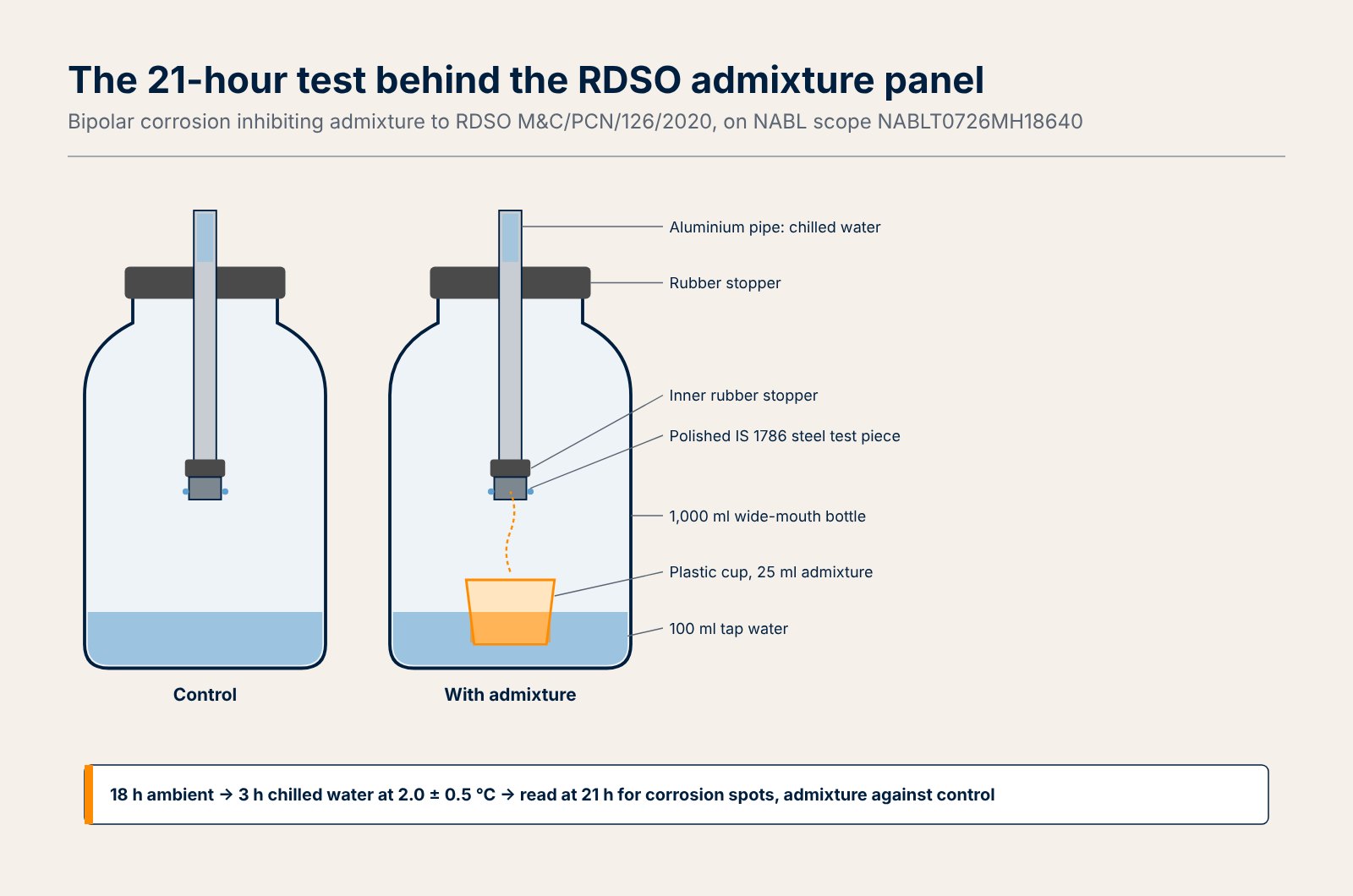
TCR Engineering tests Bipolar Concrete Penetrating Corrosion Inhibiting Admixture (BCPCIA) to RDSO Specification No. M&C/PCN/126/2020 at its Mahape laboratory in Navi Mumbai. The short-term acceptance panel, from the 21-hour accelerated corrosion test to pH, relative density and Ford cup viscosity, sits on NABL certificate NABLT0726MH18640. It needs 2 litres of admixture; the programme is confirmed in the quotation.
- Product: Bipolar Concrete Penetrating Corrosion Inhibiting Admixture, tested as supplied.
- Specification: RDSO Specification No. M&C/PCN/126/2020.
- Accelerated corrosion test: a modified accelerated corrosion test based on the Japanese standard JIS Z 1535, read after 18 + 3 = 21 hours.
- Also to the RDSO specification: appearance, odour and skin irritation.
- To IS 9103: pH and relative density.
- To IS 101 (Part 1/Sec 5): viscosity by Ford cup.
- Accreditation: every test in the panel is on the laboratory's NABL scope, certificate NABLT0726MH18640.
- Sample: 2 litres of admixture as supplied; the programme is confirmed in the quotation.
- Where it sits: between building materials testing and the corrosion and sour service bench.
Acceptance before supply, not a service-life study
A supplier who wants to sell a corrosion inhibiting admixture into railway work, and a project that has to accept one, both need the same thing first: evidence that the product in the drum meets the specification the project calls for. For a bipolar admixture on railway work, that specification is RDSO M&C/PCN/126/2020, and the evidence is a short panel of tests on the admixture itself.
That is a different question from the one asked in the wider evaluation of these products, which explains the chemistry and the long-duration performance tests. This post is about the short-term panel: what it measures, how its one corrosion test works, and what it does not claim to tell anyone.
The distinction matters because the two are easy to confuse in a tender document. A short-term acceptance test is a screen. It shows whether a product behaves as an inhibitor under a defined, accelerated condition and whether its physical properties match what the supplier declared. It is not a measure of how long reinforcement will last in a structure. Long-duration macrocell testing, such as ASTM G109-23, Standard Test Methods for Determining Effects of Chemical Admixtures on Corrosion of Embedded Steel Reinforcement in Concrete Exposed to Chloride Environments, is a separate programme that runs for months, and a project that needs service-life evidence should specify it separately.
The panel, test by test
| Test | Method | On NABL scope |
|---|---|---|
| Accelerated corrosion test | RDSO Specification No. M&C/PCN/126/2020 (modified test based on JIS Z 1535) | Yes |
| Appearance | RDSO Specification No. M&C/PCN/126/2020 | Yes |
| Odour | RDSO Specification No. M&C/PCN/126/2020 | Yes |
| Skin irritation | RDSO Specification No. M&C/PCN/126/2020 | Yes |
| pH | IS 9103 | Yes |
| Relative density | IS 9103 | Yes |
| Viscosity by Ford cup | IS 101 (Part 1/Sec 5) | Yes |
IS 9103:1999 is Concrete Admixtures, Specification, the general Indian standard for admixtures, and it supplies the pH and relative density methods here. Where acceptance is against values the supplier declared, these physical results are what the declaration is checked against, which is why an enquiry should carry the declared values (see below).
Appearance, odour and skin irritation are assessed to the RDSO specification itself. They are short tests, but they are part of the acceptance record and they are on the accredited scope like the rest.
How the accelerated corrosion test works
The RDSO specification's accelerated corrosion test is a modified version of a test based on the Japanese standard JIS Z 1535. Its appendix sets out the apparatus and the steps, and they are simple enough to describe completely.
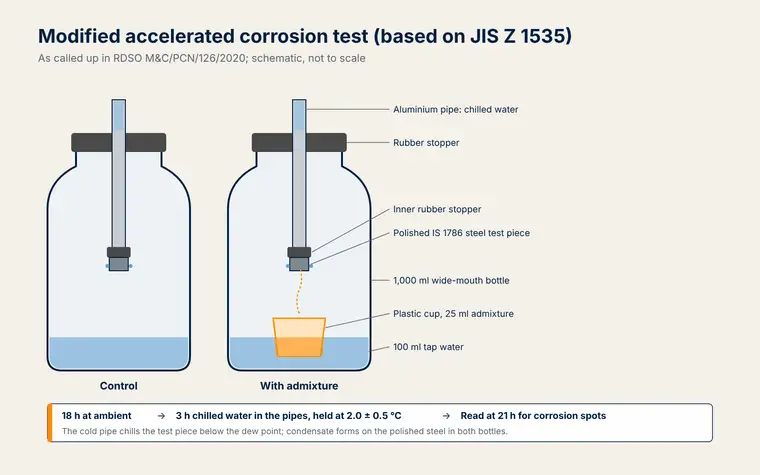
The test piece. Each steel test piece conforms to IS 1786:2008 (or its latest version), High strength deformed steel bars and wires for concrete reinforcement, Specification. It is about 15 mm in diameter and 12 mm thick, drilled centrally on one side to 10 mm diameter and 10 mm deep so that it can sit on the end of an aluminium pipe. Using reinforcement steel matters: the test asks whether the admixture protects the kind of steel it will be asked to protect, which is the steel covered on the TMT rebar and couplers page.
The surface. The test piece is cleaned to white metal with 1000 grit paper, then polished with 3/0 and finally 4/0 grit paper. A polished, freshly cleaned steel face shows a corrosion spot clearly, and it starts every piece from the same condition.
The assembly. The test piece is attached to the aluminium pipe with cello tape so that it is held firmly, and the pipe is slid up through a rubber stopper until the test piece rests in the slot provided.
The two bottles. Two 1,000 ml wide-mouth glass bottles each receive 100 ml of tap water. In one of them, a plastic cup holding 25 ml of the admixture, as supplied, is placed in the tap water. The other bottle has no admixture and is the control. The stoppers, each carrying a pipe and test piece, close the bottles.
The exposure. The bottles stand for 18 hours at ambient temperature. Chilled water below 1.0 °C is then added into the aluminium pipes and kept there for 3 hours, its temperature held at 2.0 ± 0.5 °C by changing the chilled water frequently with a pipette.
The reading. After 18 + 3 = 21 hours, the steel test pieces are observed for corrosion spots, the inhibitor bottle against the control.
Why chilled water in a pipe
The design logic is condensation. The aluminium pipe carries the cold of the chilled water down to the steel test piece, and a test piece held near 2 °C sits below the dew point of the moist air in the bottle. Moisture therefore condenses on the polished steel. In the control bottle, that film of condensate is free to rust the steel, which is what the control is there to show. In the inhibitor bottle, the admixture has had 18 hours to pass into the vapour space above the water, and the test is built on the expectation that the inhibitor present there protects the steel from the same condensate.
The test does not depend on any particular chemistry to be read. It sets up the same wet, cold steel surface in two bottles and asks one question: does the bottle with the admixture show the corrosion spots that the control shows, or not?
What the reading is, and is not
The result is an observation of corrosion spots on two pieces of steel after 21 hours. It is useful because it is direct and comparable: the same steel, the same preparation, the same water and the same thermal cycle, with the admixture as the only difference. It is also limited by the same design. It does not put the steel inside concrete, it does not introduce chloride through a cover, and it does not run for months. It is an acceptance screen, and that is how a project should use it.
"The 21-hour test reads one thing, and it reads it honestly. Two polished pieces of reinforcement steel, the same tap water, the same chilled pipe, and the only difference is 25 ml of the admixture in one bottle. At the end we look for corrosion spots on the inhibitor piece and on the control. The rest of the panel, pH, relative density, Ford cup viscosity, appearance, odour and skin irritation, is on our NABL scope, so the whole acceptance record comes from one accredited laboratory."
Parul Hariya heads civil and building materials testing at TCR Engineering, where she has more than 15 years in building material testing.
Where this panel is used
The specification is an RDSO one, so the first users are suppliers and projects in railway work. The same question, whether a corrosion inhibiting admixture in the drum is what was declared, arises on infrastructure and construction projects that adopt the RDSO specification or reference it.
| User | What the panel answers |
|---|---|
| Admixture supplier | Whether a batch meets RDSO M&C/PCN/126/2020 before it is offered for supply |
| Railway project or contractor | Whether the admixture delivered matches the specification and the supplier's declared values |
| Infrastructure and construction projects | An accredited acceptance record for an admixture called up by the project specification |
An admixture does not act alone. The concrete it goes into is tested on the concrete, cement and aggregates bench, and the cover over the steel, which the post on rebar cover testing discusses, is part of how reinforcement is protected in service. Where a project also needs the steel itself characterised, chemical analysis and rebar testing are separate services at the same laboratory.
What an enquiry should carry
The panel is fixed before the sample is opened, and the enquiry is what fixes it. Send:
- The product: product name and batch number.
- The sample: 2 litres of the admixture, as supplied, in its own container.
- The safety data sheet for the admixture.
- The specification: the revision of RDSO M&C/PCN/126/2020 that the project calls for.
- Declared values: the supplier's declared pH, relative density and viscosity, if acceptance is against declared values.
- Witnessing: whether a witnessed test is required, so that the accelerated corrosion test can be scheduled with the witness present.
With those in hand, the programme is confirmed in the quotation. The accelerated corrosion test itself runs for 21 hours, as the specification sets it.
Frequently asked questions
Which tests make up the RDSO acceptance panel for a bipolar corrosion inhibiting admixture?
The panel run at TCR Engineering, Mahape, covers the accelerated corrosion test, appearance, odour and skin irritation to RDSO Specification No. M&C/PCN/126/2020, pH and relative density to IS 9103, and viscosity by Ford cup to IS 101 Part 1 Section 5. All of these tests are on NABL certificate NABLT0726MH18640.
How long does the RDSO accelerated corrosion test take?
It takes 21 hours. The two bottles stand for 18 hours at ambient temperature, then chilled water held at 2.0 plus or minus 0.5 degrees Celsius is kept in the aluminium pipes for 3 hours. The steel test pieces are then observed for corrosion spots, the inhibitor bottle against the control bottle.
Why does the test use chilled water inside an aluminium pipe?
The chilled pipe cools the steel test piece below the dew point of the air in the bottle, so moisture condenses on the polished steel. In the control bottle that condensate can rust the steel. In the inhibitor bottle, admixture that has passed into the vapour space over 18 hours is expected to protect it.
Does the 21-hour test show how long reinforcement will last in a structure?
No. It is a short-term screen and acceptance test, not a measure of service life. Long-duration macrocell testing such as ASTM G109-23 is a separate programme that runs for months. A project that needs service-life evidence for an admixture should specify that programme separately from the RDSO acceptance panel.
How much sample does the full panel need?
TCR Engineering needs 2 litres of the admixture, as supplied, with its safety data sheet. The programme is confirmed in the quotation. The enquiry should also name the specification revision, give the supplier's declared pH, relative density and viscosity if acceptance is against them, and say whether a witnessed test is required.