
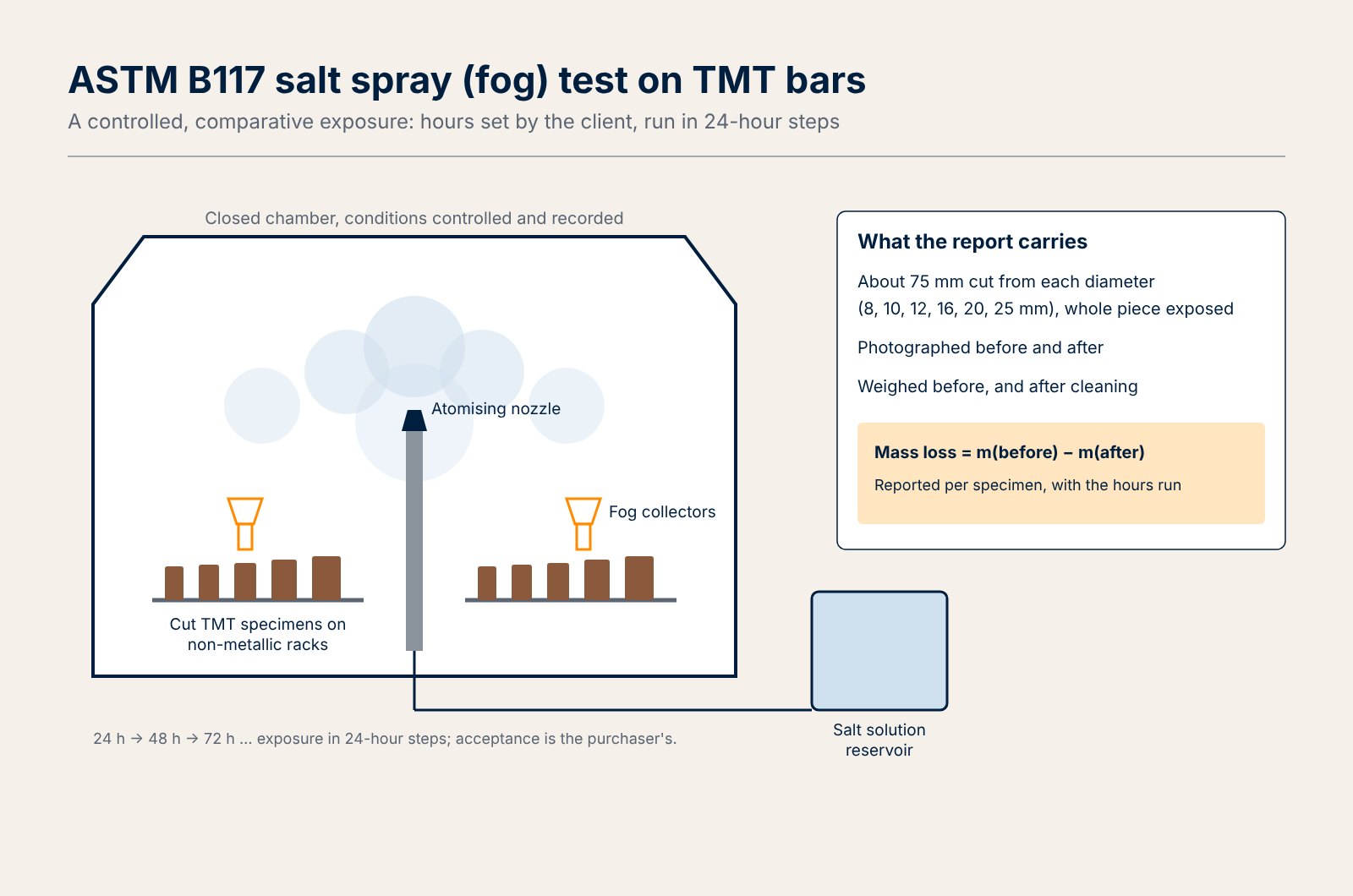
TCR Engineering runs salt spray (fog) tests to ASTM B117 at its Mahape laboratory in Navi Mumbai, under NABL accreditation certificate NABLT0726MH18640. For TMT reinforcement bars, a short length is cut from each diameter, exposed for the hours the client specifies in 24-hour steps, photographed before and after, and weighed for mass loss.
- Standard: ASTM B117, Standard Practice for Operating Salt Spray (Fog) Apparatus.
- Accreditation: ASTM B117 is on TCR Engineering's NABL scope (certificate NABLT0726MH18640) for metallic materials, with ISO 9227, ASTM B368 (CASS) and IS 6910.
- Specimen for TMT bars: about 3 inches (about 75 mm) cut from each diameter; the whole cut length goes into the chamber.
- Duration: set by the client, from the purchaser's specification or contract, and run in 24-hour steps.
- Evidence: photographs of every specimen before and after exposure, and mass loss from weighing before and after.
- Turnaround: for a 24-hour test, the report is issued within 2 to 3 working days.
- What it is: a controlled, comparative test. It is not a prediction of service life.
The enquiry that sets the worked case
A buyer asked for salt spray reports on TMT steel in six diameters: 8, 10, 12, 16, 20 and 25 mm. It is a common shape of request on the construction and infrastructure side, and a useful one to walk through, because every decision in it is one the purchaser or the laboratory has to make in writing: which bars, how many specimens of each, how many hours, bare or coated, and what the report must show.
The product itself is specified elsewhere. TMT bars are made and bought to IS 1786:2008, High strength deformed steel bars and wires for concrete reinforcement: Specification, which governs grade, chemistry and mechanical properties. The salt spray duration is not something the laboratory chooses. It comes from the purchaser's specification or contract, and the report states the hours that were run.
What ASTM B117 is
ASTM B117 is titled Standard Practice for Operating Salt Spray (Fog) Apparatus, and the title is accurate. It describes how to build, run and control the cabinet: the salt solution, the atomisation, the collection of fog to confirm the chamber is performing, and the chamber conditions B117 prescribes. TCR controls those conditions and records them for each run. It does not set a test duration, and it does not set an acceptance criterion for any product. Those belong to the product specification or the purchase contract.
The international counterpart is ISO 9227:2022, Corrosion tests in artificial atmospheres: Salt spray tests. It carries three variants:
| Variant | Name | Typical use |
|---|---|---|
| NSS | Neutral salt spray | The general comparative test, closest in purpose to ASTM B117 |
| AASS | Acetic acid salt spray | A more aggressive acidified fog, often specified for coatings |
| CASS | Copper-accelerated acetic acid salt spray | A further accelerated variant, also published as ASTM B368 |
All four methods named here (ASTM B117, ISO 9227, ASTM B368 and IS 6910, the acetic acid salt spray test) are on TCR Engineering's NABL scope for metallic materials. A specification that names one of them can be tested against that method as written.
Why the result is comparative
The most important sentence about salt spray testing is in ASTM B117 itself. The standard says that prediction of performance in natural environments has seldom been correlated with salt spray results when they are used alone. A bar that survives a given number of hours in the cabinet has not thereby been shown to last a given number of years in a coastal pier, a bridge deck or a foundation.
What the test does well is compare. Every specimen sees the same controlled fog for the same time, so differences between them are differences in the material or its surface, not in the weather. That makes the test useful for:
- comparing heats, suppliers or production lots of the same grade against each other;
- comparing a coated bar against a bare bar, or one coating system against another;
- checking a supply against a purchaser's own benchmark, where the purchaser has set one;
- keeping a consistent, repeatable record of how a material behaved under one defined exposure.
A purchaser who reads a salt spray report as a durability guarantee is reading more into it than the method supports. A purchaser who reads it as a controlled comparison, under conditions any accredited laboratory running the same method can reproduce, is reading it correctly.
How TCR runs it for TMT bars
The practice at Mahape for reinforcement bar is set out below, step by step, as it was applied to the six-diameter enquiry.
- Cutting. A specimen of about 3 inches (about 75 mm) is cut from each diameter supplied. For this enquiry that is six specimens, one each of 8, 10, 12, 16, 20 and 25 mm, or more where the purchaser asks for more per diameter.
- Whole length exposed. The whole cut length of bar goes into the chamber, ribs, cut ends and all, so the specimen carries the bar's real rolled surface.
- Photographing. Each specimen is photographed before exposure, so its starting condition is on the record.
- Weighing. Each specimen is weighed before it goes in.
- Exposure. The specimens are exposed under the chamber conditions B117 prescribes, for the number of hours the client has specified, in 24-hour steps: the first 24 hours, then each additional 24 hours.
- After exposure. Each specimen is photographed again, the corrosion product is cleaned off, and the specimen is weighed again. The difference is the mass loss.
- Reporting. The report gives the method, the hours run, the before and after photographs and the mass loss for each specimen.
For a 24-hour test the report is issued within 2 to 3 working days. Longer exposures add their own hours to that.
Mass loss is what turns an appearance test into a measured one. Photographs show where and how a bar has rusted; the balance shows how much metal has gone. Read together, they let a purchaser compare six diameters, or two suppliers, on numbers as well as on pictures.
TCR reports what it observes and measures. Where the purchaser has an acceptance criterion, the purchaser applies it; the laboratory does not pass or fail a bar against a limit it has not been given.
"Salt spray is a comparison, not a forecast. The client tells us how many hours the specification calls for, and we run those hours in 24-hour steps under the conditions B117 sets, which we control and record. For TMT bars we cut about 75 mm from each diameter and put the whole piece in. Every specimen is photographed and weighed before it goes in and again after it is cleaned, so the report carries pictures and a measured mass loss, not an opinion."
Manoj Prabhakar Singh heads corrosion testing at Mahape, where the salt spray cabinet sits on the same corrosion and sour service bench as the laboratory's immersion and intergranular corrosion work.
Bare bars, coated bars and other parts
The six-diameter enquiry was for bars, but the enquiry should say whether they are bare or coated. Epoxy-coated and galvanised bars are tested the same way, and the comparison then becomes one of coating against coating, or coated against bare. The coating itself is assessed on the coating evaluation bench, and a salt spray result is most useful when it sits beside that record.
The same chamber serves coatings and plated parts generally. The acidified variant is set out in the note on why aluminium powder coating needs an acetic acid salt spray (AASS) test. Where the question is how a metal behaves in a particular liquid rather than a fog, the method is a laboratory immersion test, described in the post on ASTM G31 immersion corrosion testing at Mahape.
Where salt spray sits in a TMT bar test programme
A salt spray report answers one question about a bar. The other questions are answered by other benches, and a purchaser qualifying a supply usually wants several of them:
| Question | Where TCR answers it |
|---|---|
| Does the bar meet its grade's chemistry? | Chemical analysis |
| Does it meet its tensile and bend requirements? | Mechanical testing |
| How do mechanical couplers on the bar perform? | TMT rebar and couplers |
| How well does the bar bond in concrete? | The pull-out test on TMT bars |
| Is the bar placed with the cover the drawing requires? | Rebar cover meter survey, and the note on rebar cover testing in India |
| How do the other building materials perform? | Building materials testing |
For mills and stockists on the steel and metals side, a salt spray requirement usually arrives through a purchaser's specification. Planning it with the rest of the programme means the bars for every test can be sampled in one round.
What an enquiry should carry
The test is fixed in writing before the specimens go in. Send:
- The bars: the diameters and the grade, and whether the bars are bare or coated (for example epoxy or galvanised).
- The quantity: the number of specimens per diameter.
- The hours: the exposure duration required, which the laboratory runs in 24-hour steps.
- The specification: the purchase specification, contract or tender clause that calls for the test.
- The acceptance criterion: if the purchaser has one, so it can be stated alongside the result. TCR reports what it observes and measures; acceptance is the purchaser's decision.
Frequently asked questions
What does an ASTM B117 salt spray test show for TMT bars?
It shows how the bars behave under one controlled, repeatable salt fog exposure, recorded as before and after photographs and as mass loss from weighing. It is a comparative test, useful for comparing lots, suppliers, diameters or coatings. ASTM B117 itself notes that salt spray results used alone have seldom been correlated with performance in natural environments.
How many hours of salt spray exposure does TCR run?
The number of hours is set by the client, from the purchaser's specification or contract, not by the laboratory. TCR runs the exposure in 24-hour steps, the first 24 hours and then each additional 24 hours, and the report states the hours that were actually run.
What specimen does TCR need from each TMT bar diameter?
TCR cuts a specimen of about 3 inches, or about 75 mm, from each diameter supplied, and the whole cut length goes into the chamber. The enquiry should state how many specimens are wanted per diameter, the grade, and whether the bars are bare or coated.
Is salt spray testing on TCR Engineering's NABL scope?
Yes. TCR Engineering's NABL scope under certificate NABLT0726MH18640 includes the ASTM B117 salt spray (fog) test, the ISO 9227 salt spray test, ASTM B368 copper-accelerated acetic acid salt spray and IS 6910 acetic acid salt spray, all for metallic materials, at the Mahape laboratory in Navi Mumbai.
How soon is the salt spray report issued?
For a 24-hour test, TCR issues the report within 2 to 3 working days. Longer exposures add their own hours to that. The report carries the method, the hours run, the before and after photographs and the measured mass loss for each specimen.
Does TCR pass or fail the bars?
TCR reports what it observes and measures: the photographs and the mass loss. Acceptance belongs to the purchaser. Where the purchaser has an acceptance criterion, it should be sent with the enquiry so it can be stated alongside the result, but the decision against that criterion remains the purchaser's.